(Unila): The Rector of the University of Lampung (Unila), Prof. Dr. Ir. Lusmeilia Afriani, D.E.A., IPM., ASEAN Eng., reflects that crises faced by higher education institutions do not always lead to a fall in reputation.
If managed with system resilience, transparency, and adaptive governance (Good University Governance), crises can actually be transformed into a significant momentum for quality leaps and public trust restoration.
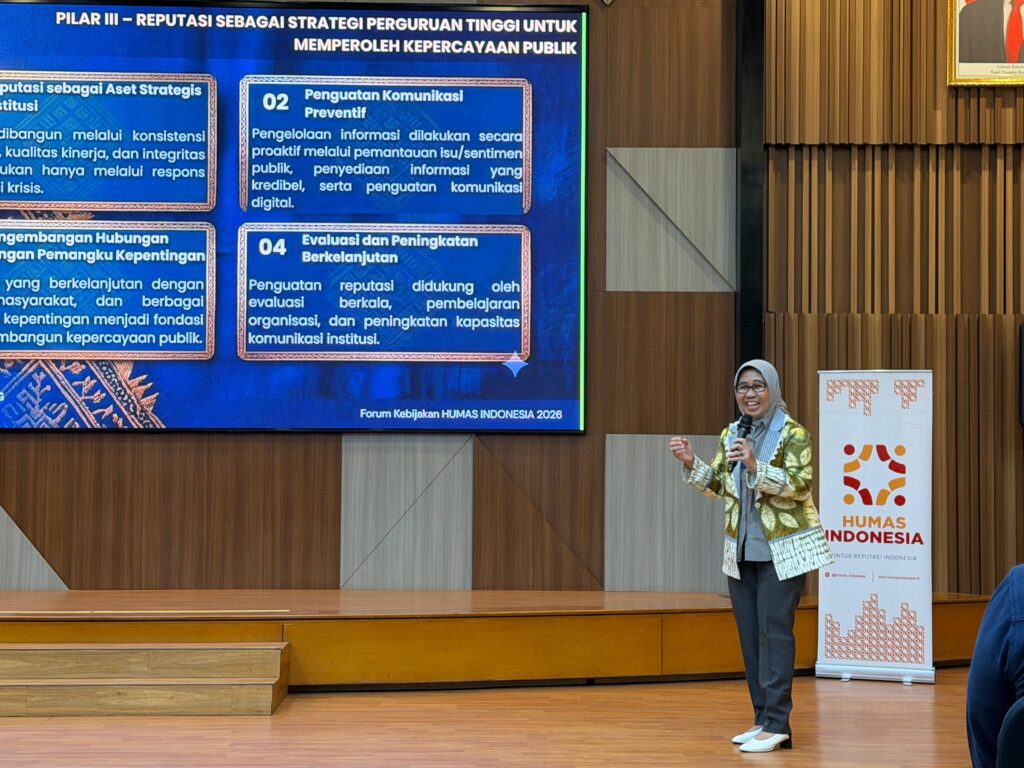
This statement was made as Prof. Lusmeilia presented her views during the Insight Session of the Strategic Communication Policy and Technical Guidance Forum, a collaborative forum by HUMAS INDONESIA and the Ministry of Education and Technology, in Jakarta, Wednesday, July 22, 2026.
The event, titled “Crisis Management in Higher Education in the Digital Era,” was opened by the CEO of HUMAS INDONESIA, Asmono Wikan, and featured the Head of the General Bureau, Public Relations, and PBJ of the Ministry of Education and Technology, Manifes Zubair, alongside several leaders from prominent universities in the country such as UGM, ITB, IPB, and Undip.
In his opening remarks, Asmono Wikan highlighted Unila’s track record in facing communication storms in recent years. According to him, Unila’s experience serves as a valuable case study for the higher education ecosystem in Indonesia.
“Crisis is not always detrimental. There is the ability to turn a crisis into a blessing. We know that Unila’s journey in managing the Rector’s communication crisis was not easy, but Unila has proven its ability to rise and gain greater value thanks to transparent leadership and mature public relations governance,” said Asmono.
Four Pillars of Unila’s Crisis Management Architecture
Presenting a material titled “Navigating Reputation in the Era of Information Disruption: Crisis Management Architecture of the University of Lampung,” Prof. Lusmeilia Afriani revealed that in the digital era, internal campus issues can transform into national crises in just a matter of hours.
As a value-based institution, higher education is required to carefully balance the need for rapid response in the era of social media with the principles of accurate academic verification. In response to these disruption challenges, Unila has formulated four main pillars of reputation management.
This approach positions higher education institutions as moral guardians and the intellectual face of the nation through the reinforcement of integrity, critical thinking, and exemplary leadership (leading by example).
These characteristics are then supported by the institutionalization of crisis communication based on Good University Governance (GUG), which is manifested in standard operating procedures (SOPs), risk mitigation mechanisms, and data-driven transparency.
Moreover, Unila places reputation as a strategic asset that is safeguarded through proactive partnerships with stakeholders and preventive communication before an issue escalates.
All of this foundation culminates in effective and empathetic public communication, combining active listening, multi-channel strategies, and narrative delivery that consistently aligns with the institution’s real achievements.
“The role of public relations in higher education today is no longer just about putting out fires or issuing press releases, but is the frontline in determining reputation and organizational sustainability. We at Unila have learned that reputation resilience can only stand firm on the foundations of accountability and transparency,” emphasized Prof. Lusmeilia.
Unila’s transformation in governance and communication has proven fruitful. Between 2022 and 2025, Unila consistently received dozens of prestigious awards in the Diktisaintek Public Relations Awards (AHD) of the Ministry of Education and Technology, and the Media Public Relations Award (AMH) of the Ministry of Communication and Informatics, including Gold Winner in the categories of Press Release, Magazine, Website, and Social Media.
Synergy of Crisis Communication Stages
In line with the views of Unila’s Rector, the Head of the General Bureau, Public Relations, and PBJ of the Ministry of Education and Technology, Manifes Zubair, also elaborated on five standard stages of crisis communication management that must be adapted by both public and private higher education institutions throughout Indonesia.
This process begins with the establishment of a crisis strategy by leadership through the appointment of a spokesperson and a rapid response team, which is then followed by issue mapping, risk analysis, and the determination of key messages.
In the next stage, the institution develops a response plan and strengthens internal coordination before moving on to the collection, verification of data, and formulation of accurate narratives.
This systematic flow culminates in the delivery of strategic recommendations as a basis for making precise and measurable public communication decisions. The entire formulation and exchange of ideas during this event are directed to provide a tangible impact for the higher education ecosystem.
The forum, attended by 150 leaders and public relations practitioners from higher education institutions across Indonesia, aims to produce a White Paper on the National Higher Education Crisis Communication Roadmap as a standard guide for crisis mitigation in the digital era.
Through active contributions to this national event, Unila strengthens its position towards Vision Unila 2045 as a world-class university that excels and is sustainable with a governance foundation of BE STRONG. [Gandhi Irawan]