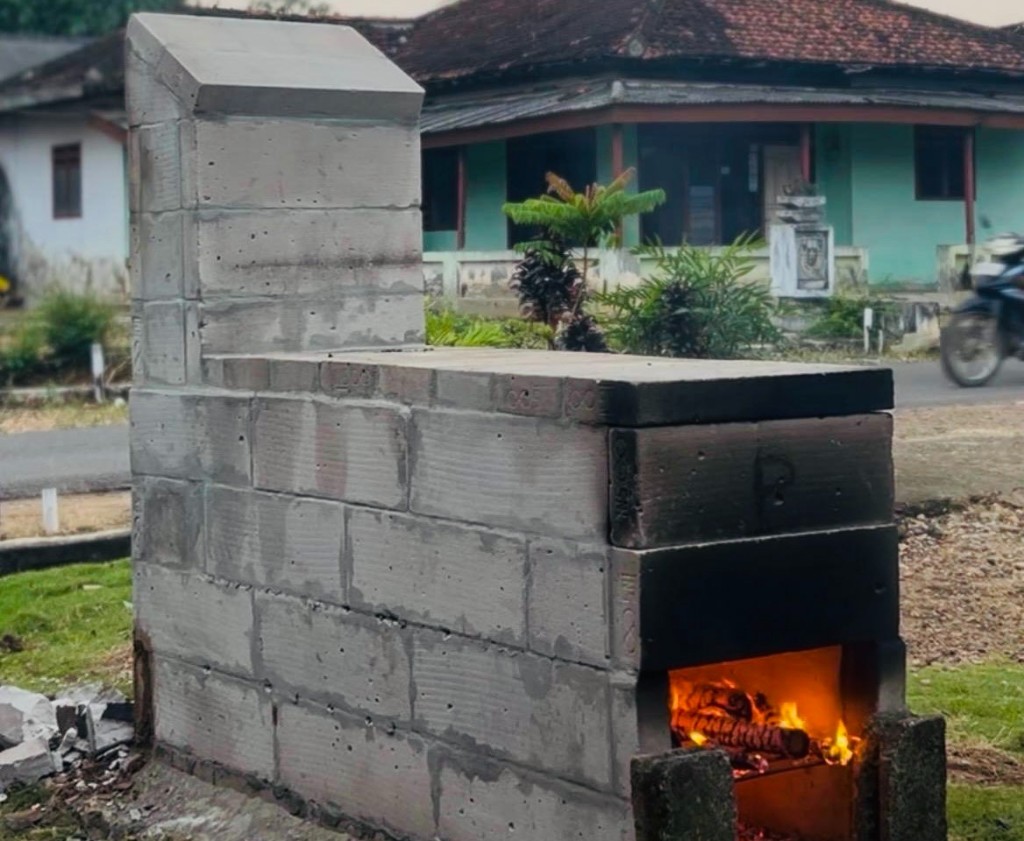
(Unila): Students of the Community Service Program (KKN) of the University of Lampung (Unila) period I in 2026 carried out a work program to build an incinerator or a place to burn waste with minimal smoke, some time ago, in Hamlet 2, Margo Lestari Village, Jati Agung District, South Lampung Regency.
This work program was initiated by the Margo Lestari Village Community Service Team, led by Fahmi Daris (Agricultural Engineering) with members Riska (Chemistry), Habib (Agricultural Product Technology), Ilham Oktora (Sociology), Ovita (Economics and Business), Nafiska (International Relations), Adel (Agricultural Engineering), Andhira (Geophysical Engineering), Faiz (Agronomy and Horticulture), Kaisar (Public Administration), and Yusuf (Development Economics). This activity was accompanied by Field Supervisor Lecturer (DPL), M. Wendy Trijaya, SH, M.Hum.
This program was implemented in response to the public’s continued practice of openly burning household and farm waste. The lack of waste disposal facilities has led residents to resort to burning or burying their own waste, which can potentially lead to accumulation and smoke pollution.
The program’s chief executive, Fahmi Daris, explained that the Community Service Program (KKN) team chose an approach that adapts to community habits. He stated that the team is working to improve the method to be more structured and smoke-free by building an incinerator. This method was chosen through discussions with team members, village officials, and consideration of field conditions.
The incinerator is designed to resemble a closed furnace equipped with air vents and a chimney. It has three layers: a ventilation chamber and ash reservoir at the bottom, a fuel chamber in the middle, and a waste combustion chamber at the top. The closed combustion system allows for higher temperatures, maximizing combustion and minimizing waste residue.
The incinerator’s construction began with the design and selection of heat-resistant materials, such as hebel (aluminum concrete) and 8-millimeter-diameter steel. The work was carried out in collaboration with village officials and local residents with construction experience. The incinerator was built with a large enough capacity to accommodate multiple households simultaneously.
The type of waste that can be managed using this tool is waste that can be decomposed through combustion, except for glass and rubber waste which has the potential to produce black smoke in the initial stages of combustion.
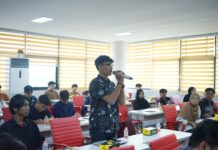
After completing the trial phase, the KKN team held outreach and demonstrations on the incinerator’s use with the community. Sustian, a resident of Hamlet 2, expressed his appreciation for the program. He noted that the incinerator helps reduce smoke and prevents waste from accumulating for long periods, thus providing greater benefits to local residents.
This program provides a more organized waste management alternative for the residents of Margo Lestari Village. The KKN team hopes this innovation can be utilized sustainably, enabling more systematic and environmentally friendly waste management at the village level. [Muzamil Kakar]