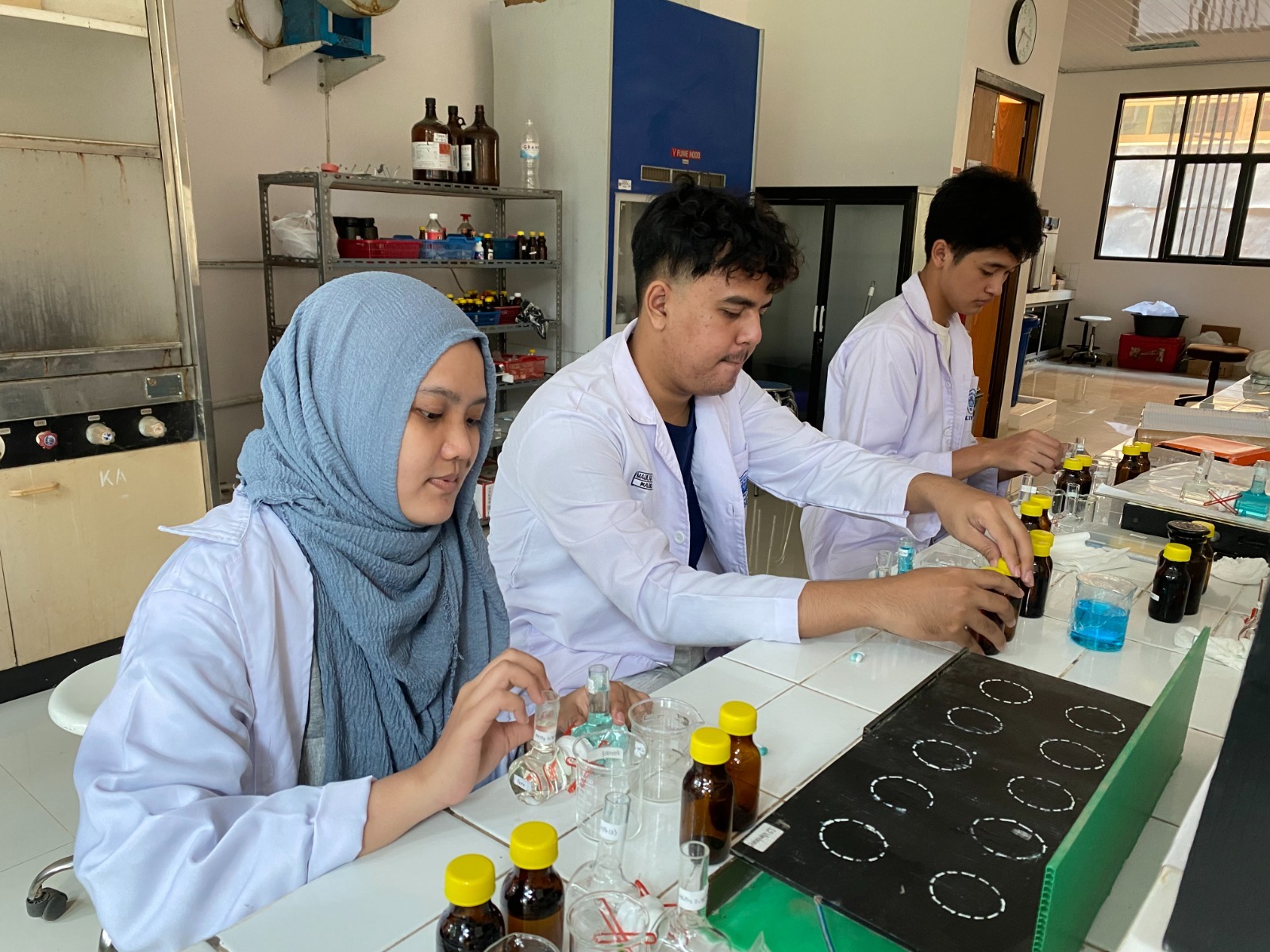
(Unila): Four students of the Chemistry Department of the Faculty of Mathematics and Natural Sciences, the University of Lampung (Unila) conducted research on the treatment of malachite green (MG) dye waste making use of the polymer inclusion membrane (PIM) method based on polyeugenol.
The results showed that removal of dye waste reached 80%. This suggests that the polyeugenol carrier compound contained in the PIM membrane can absorb malachite green from the waste solution up to 80 per cent.
This research was funded by the Kemristekdikti student creativity programme of research for natural sciences (PKM-RE), with the research team, Annur Valita Sindiani, a team leader, and three members, Rizqohayyu Khusnul Khotimah, Maulana Rabbani, and Bagus Kurniawan with the supervisor, Dr Agung Abadi Kiswandono.
The research was carried out for three months, June-September 2023, at the Analytical Laboratory and Chemical Instrumentation, FMIPA Unila, UPT LTSIT Unila, and the National Research and Innovation Agency (BRIN) Bandung.
Malachite green constitutes a textile dye waste that is carcinogenic and very dangerous for the environment and living things. When discharged into waters without prior treatment, malachite green may cause disease and death of river and sea biota.
If the water contaminated with malachite green is consumed by humans for daily needs, it can result in skin irritation, eye irritation, respiratory problems and cancer.
The testing process in the laboratory was made into two phases, the source phase containing malachite green dye solution, and the receiver phase including HN03 or nitric acid solution. The two substances are then put into different tubes, but have a connecting channel in the middle with a PIM membrane.
The PIM membrane method was chosen because it has excellent stability, wider interfacial surface, high selectivity, good strength, and easy separation process. In addition, PIM membrane is an environmentally friendly method as it does not require many carrier compounds and solvents.
The PIM membrane used in our research is made from a mixture of three compounds, namely polyvinyl chloride, dibenzyl ether, and polyeugenol carrier compound. The ability of the polyeugenol-based PIM membrane was tested to absorb and retain the dye in the source phase.
Rizqohayyu described five treatment variations in the malachite green waste treatment trial. First, the pH variation of the malachite green source phase solution included pH-5, pH-6, pH-7, pH-8, and pH-9.
The results showed the maximum performance as indicated by normal pH or pH-7 in the source phase. Second, variations in the concentration of the receiving phase HNO3 or nitric acid contained concentrations of 0.75 molar, 1 molar, and 1.25 molar. The maximum performance results were shown by the HNO3 concentration of 0.75 molar.
Third, the thickness of polyeugenol PIM membrane was specifically designed for thin, medium, and thick variations. The maximum performance was found out in the medium or normal thickness membrane with a total weight of 0.540 grams.
Fourth, the variation of polyeugenol concentration in the manufacture of PIM membranes contained concentrations of 0.01; 0.02; 0.03; 0.04; and 0.05 molar. The maximum membrane performance with the cleanest results was shown by 0.04 molar concentration of polyeugenol.
Fifth, the five variations of malachite green transport time from the source phase to the receiving phase included 30 hours, 24 hours, 18 hours, 12 hours, and 6 hours. The transport time of 24 hours was found out the most effective. This indicates that the blue coloured source phase turns clear within 24 hours.
This research was also extended to explore the effect of PIM membrane to reduce the waste containing heavy metals particularly added to the source phase of the malachite green solution, namely Cu (II) (copper) and Pb(II) (lead). The results showed that the PIM membrane was able to reduce the heavy metal content in the source phase.
The results of this research have been disseminated on a national scale with the title “Transport of Malachite Green Using the Polymer Inclusion Membrane (PIM) Method Containing Polyeugenol: Effects of Heavy Metals and Repeated Use”, as well as the Ulicoste international seminar with the title “Transport of Malachite Green Using the Polymer Inclusion Membrane (PIM) Method Containing Polyeugenol: Effects of Heavy Metals and Repeated Using”.
In addition, this research has been published in the International Journal Q-2 with the title “Transport of Malachite Green Using the Polyeugenol Based Polymer Inclusion Membrane (PIM) Method” and the resulting output has received Intellectual Property Rights (IPR). [PR Team]