
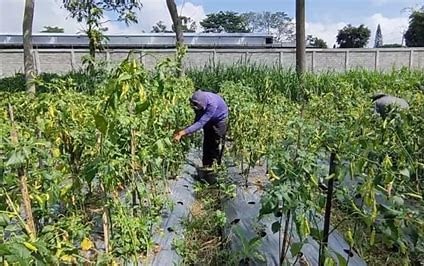
(Unila): The Faculty of Agriculture (FP), Unila provided chilli farmers in Sungai Luar village, East Menggala, Tulang Bawang with strategies to control chilli pests in the rainy season. The chilly farmers took advantages of this activity in that they got knowledge of eradicating chilly pests.
So far, farmers have used pesticides to eradicate pests and this has resulted in pest resistance due to excessive and long-term use of pesticides as described by two lecturers from the Faculty of Agriculture’s Mobile Agricultural Clinic (KPK) team, Efri, M.S., and Dr. Sudi Pratomo,
Efri shared tips on how to plant chilies. Farmers need to first neither select the waterlogged land nor land used for eggplant plants. They need to use seeds of virus-, pathogen- and wilt-resistant varieties and then to pay attention to land sanitation, which is free from leaves, fruit infested with pests, or weeds, and to make sure the equipment used should be clean.
The next step is the process of balanced fertilisation, spending at least 1 kg of fertilizer per plant and using dolomite to increase soil Ph. Control chilli pests and diseases, as well as proper post-harvest handling.
He pointed out that patek or anthracnose caused by the fungus colletotrichum sp and the fruit fly bactrocera sp were regarded as sorts of predominant diseases of chillies particularly in the rainy season which led to rotten chilli fruit.
He further suggested farmers to increase the amount of nutrients such as calcium when chilli plants are bearing fruit and phosphate when the plants are about to flower respectively.
Protective fungicides made from copper hydroxide or vegetable fungicides could also be used as alternatives to eradicate pests. It is also suggested to rotate crops and install pest traps to protect chilly plants from pests particulalrly those resistant to pesticides in addition to using the right pesticides.
According to him, crop rotation can reduce the intensity of the attack of pathogens and fruit flies. For crop rotation, choose rice, corn, cabbage and onions, not tomatoes or aubergines.
Meanwhile, pest traps can be made using old mineral water bottles painted in a bright colour, such as green, and then given pest adhesive. This bright colour will attract pests to come closer and stick to the bottle so that they can no longer fly, then die.
Varieties of Chilli Diseases
Meanwhile, Sudi Pratomo described kinds of chilli plant diseases, their symptoms, and how to overcome them. Among them are leaf spots caused by Cercospora sp. The symptoms are characterised by circular spots on the leaves, then reddish-brown in colour. Severe attacks cause the leaves to turn yellow and fall off.
“To control it, clean the leaves attacked by pests and destroy them, set the planting distance not too tightly in the rainy season, do crop rotation, and spray macoban 2.5g/l, and if the attack is severe, 1-2 ml custodia can be added,” he said.
For patek or anthracnose disease, the symptoms are signed with brown-black spots on the surface of the fruit, then soft rot. Old fruit is more susceptible to attack and is carried over to post-harvest. Attacks highly occurred during the rainy season.
“Control can be made by selecting pest-resistant chilli varieties, doing crop rotation, harvesting, and burning the infested fruits. Fungicide spraying can also be applied using custodia 2-3 ml/l + macoban 3 g/l and remazole-P 2-3 ml/l + odeon 3 g/l,” he said.
Sudi Pratomo also told farmers other types of diseases that often attack chilli plants, such as bacterial spots caused by xanthomonas campestris, phytophthora caused by pytophthora capsici, powdery mildew caused by oidiopsis sicula, teklik caused by choanephora sp, and bacterial wilt and fusarium wilt. [PR Team]