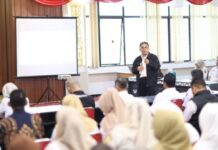
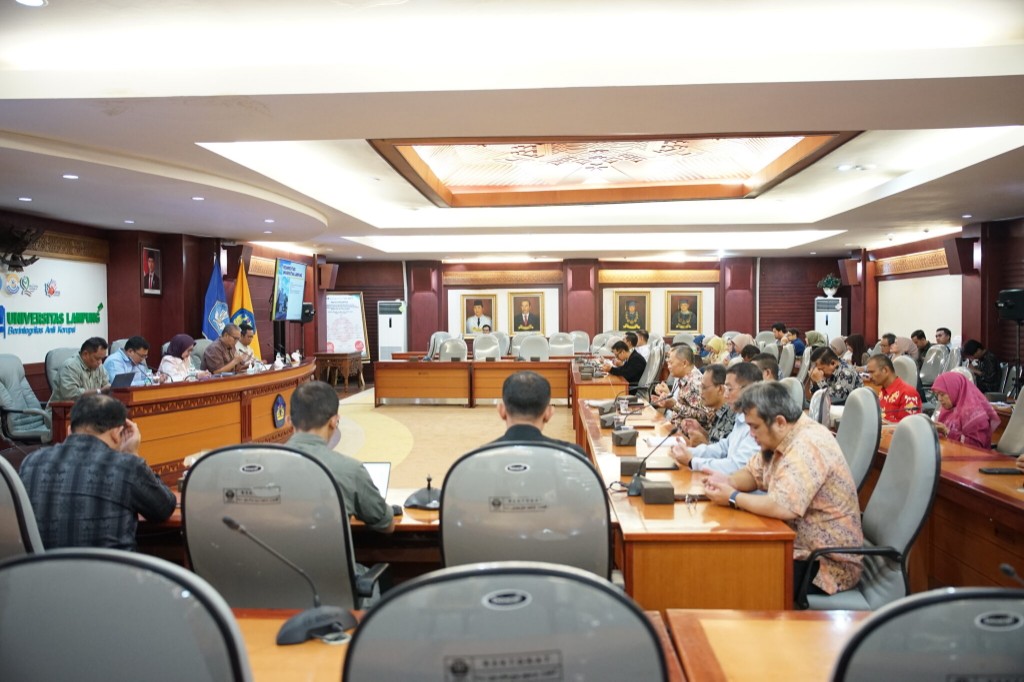
(Unila): The University of Lampung (Unila) held a coordination meeting for the 2026 reaccreditation application of the University of Lampung, in the main meeting room on the second floor of the Rectorate, on Wednesday, January 21, 2026.
This coordination is a strategic first step in preparing the institution’s reaccreditation process in a planned and sustainable manner. The event was opened by Unila Rector Prof. Dr. Ir. Lusmeilia Afriani, D.E.A., IPM., ASEAN Eng.
This activity was attended by the vice rectors, deans, vice deans, heads of bureaus, heads of institutions, and heads of Academic Support Units (UPA) within Unila.
In her remarks, the Rector stated that Unila has now achieved an Excellent accreditation rating, which is valid until December 26, 2026.
This achievement is a proud institutional achievement and proof of Unila’s commitment to maintaining and improving the quality of higher education.
However, the Rector emphasized that the Superior accreditation status is not the final goal, but rather the initial step to ensure the sustainability of the institution’s quality and competitiveness.
The Rector explained that the coordination activity for university reaccreditation applications was a strategic and visionary step as a form of Unila’s readiness to face the reaccreditation process systematically.
Reaccreditation is seen not merely as fulfilling instruments or collecting documents, but as a reflection of the quality of governance, quality culture, and consistency of institutional performance that has been running at Unila.
On this occasion, the Rector also emphasized the strategic role of the university reaccreditation task force team.
This team is expected to be able to present a complete, logical, and evidence-based institutional narrative, ensure the linkages between policies, implementation, evaluation, control, and quality improvement, and maintain data consistency across units and across periods.
The Rector hopes that the task force team can work collaboratively, openly, and proactively, while also making the reaccreditation process a momentum for reflection and strengthening Unila’s internal quality assurance system.
Furthermore, she said that Unila has very strong capital, both in terms of human resources, academic systems, achievements of the Tri Dharma of Higher Education, and cooperation networks.
The challenge going forward is how to manage all of these strengths in an integrated and well-documented manner so that they can be demonstrated convincingly in the reaccreditation process.
Through this coordination activity, Unila is expected to be able to build a common perception and commitment across the task force team, develop a roadmap and clear division of roles, and identify areas that need to be strengthened early on.
With thorough preparation, Unila is optimistic that it can maintain and even strengthen its Superior accreditation ranking in the 2026 higher education reaccreditation process. [Muzamil Kakar]