(UNila): The University of Lampung (Unila) continues to raise student participation in the MBKM program through research and scientific works.
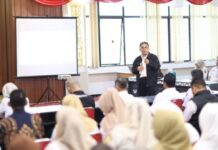
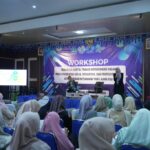
Dr. Feni Munifatullah, the head of the center for curriculum development and management of MBKM, stated that in collaboration with the research and community service center (LPPM), lecturers were invited to ensure that students participated in a research for at least one semester or twenty credits.
According to Feni, MBKM engages in eight types of activities: student exchanges, internships, entrepreneurship, teaching assistance, thematic service learning (KKN), independent study projects, and research.
She also said that a breakthrough in terms of increasing student participation in research has been made this year. An attempt has also been made to involve students in research and to provide them with opportunities to incorporate scientific work into MBKM activities.
According to her, so far student participations in academic competitions or scientific works appear to have not been recorded as academic activities. To that end, student research or scientific work needs to be credited to courses for the MBKM programme.
For instance, engineering students participating in a robot competition and allowing them to work on their projects for more than one year are necessarily acknowledged as courses equal to 40 credits.
This needs to be recorded by the study program. Meanwhile, other MBKM activities, such as student exchanges, internships, teaching assistance, thematic KKN, and humanitarian projects, continue to operate.
Feni hopes that the participation of Unila students in MBKM activities, in which some 1,987 students are taking part, continue to raise in numbers with reference to the agreement between the Unila’s Rector and the Ministry of Education and Culture, requiring a minimum of 30% (9,000 students) of the university’s total 40,000 students to participate in MBKM activities.
MBKM Grants Feni revealed that Unila was awarded four schemes of MBKM grants, three of which are particularly intended as an attempt to improve the independent learning curriculum for the study programs of biology, mathematics, and physics.
The other grant from the merdeka center of excellence for merdeka learning was awarded to the mechanical engineering study program. Three types of MBKM activities should be put in place through this center of excellence, i.e., internships at PTPN VII and PTBA, research at LIPI Tanjung Bintang, student exchanges with the Itera campus, and entrepreneurship.
According to Feni, the campus of excellence program is modelled after 80 public and private universities. The universities receiving these sorts of assistance should be capable of developing models and demonstrating merdeka learning activities on the merdeka campus. [PR Team]