(Unila): The lecturer team at the University of Lampung (Unila) has advanced innovations in recycling sorts of organic wastes both from the market and households.
The product called the carrier solution (LI) is used as catalyst to convert leachate (liquid organic waste) to liquid organic fertilizer (POC) and compost.
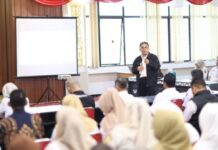
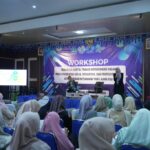
The lecturer team, Yul Martin, Lina Marlina, and Notiragayu, chaired by Syaiful Bahri introduce innovation of recycling waste to the community members in Rukti Endah Village, Seputih Raman District, Central Lampung Regency on June 29th.
Syaiful Bahri said that the area of Rukti Endah village, Seputih Raman district, was chosen as the site for the community service as the majority of the population work as farmers.
The community in the region has recently found it hard to obtain subsidized fertilizers; this has motivated the team to facilitate the community to produce fertilizers, recycling wastes generated both from households and markets.
The community service with the title “Organic Fertilizer from Kitchen Waste to Overcome Shortage of Subsidized Fertilizer in Rukti Endah Village, Seputih Raman District, Central Lampung Regency” by a Community Service Lecturer from the Department of Chemistry, Mathematics and Agriculture, the University of Lampung.
“The process started from counseling about sorting sorts of wastes by the type, like organic and inorganic,” said Syaiful Bahri.
He explained that the 3R refers to the technique for the community to be an independent waste management, sorting the organic from non-organic waste. The organic waste is then ground to produce finer-sized waste. The organic waste which has been refined in size is then pressed to produce liquid (leachate) and leave the solid waste.
“This liquid (leachate) is then processed into a variety of products such as liquid fertilizer and pesticides and the solid is converted to animal feed and compost,” he said.
The program is expected to improve community’s capability of recycling organic waste to liquid organic fertilizer (POC) and its derivative products. Meanwhile, the organic solids can be converted to animal feed and compost which in turn enables farmers to overcome the scarcity of subsidized fertilizers.
Yul Martin, a team member, admitted that the increasing amount of domestic waste has not been properly recycled that the environmental balance was disrupted.
“This circumstance suggests that the recycling of domestic waste to compost and liquid organic fertilizer (POC) products is expected to be a way out of sorting out the scarcity of subsidized fertilizers in the village,” said Yul Martin.
He explained that activities of community service took the forms of socialization and training regarding the working process of the waste processing equipment, as well as the demonstrations on making use of household kitchen organic waste processing equipment into compost and liquid organic fertilizer (POC).
“The activities are expected to have a positive effect on the residents’ knowledge of recycling waste at Rukti Endah village which in turn may increase entrepreneurial motivation and the local economy,” he said.
“Public awareness of the prospects of developing compost and POC fertilizer products needs to be maintained to prevent the community from the scarcity of subsidized fertilizers and to improve their economy, especially in Rukti Endah village,” he concluded. [PR Team]