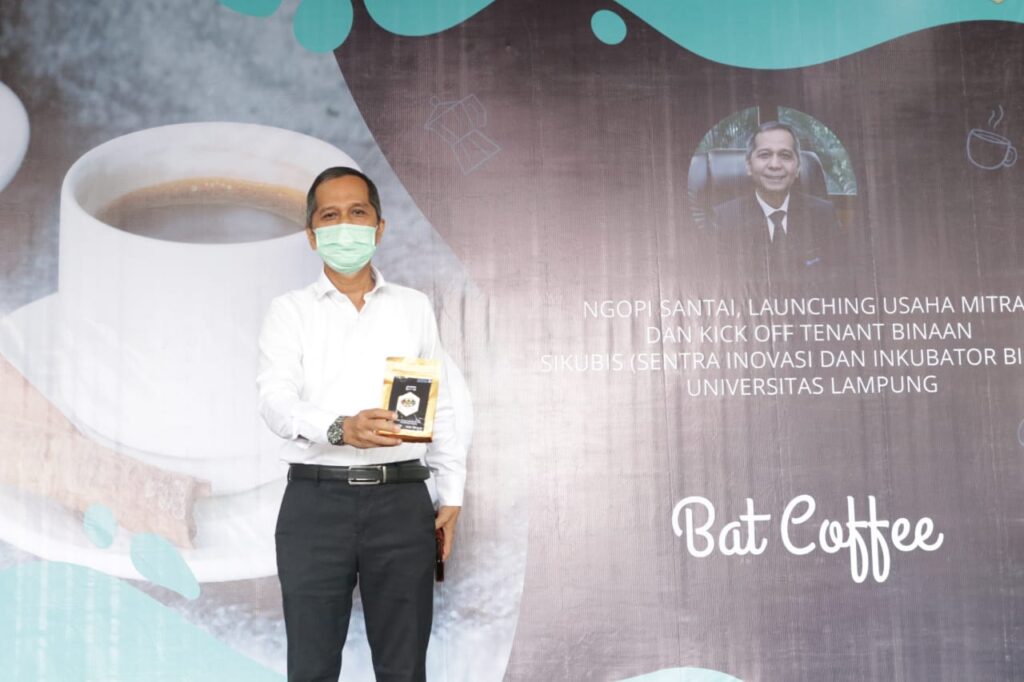
(Unila): The innovation and business incubator center, the University of Lampung (Sikubis Unila), introduces innovation of bat coffee, one of the excellent coffee products, promoting Lampung’s local wisdom.
The launch of the bat coffee product, which is a business partner of Sikubis Unila, was officially performed by the rector of Unila, Prof. Dr. Karomani, M.Sc., and also attended by the vice rectors and the Unila academic staff, Friday morning, June 4, 2021, in the front yard of the Unila Rectorate Building.
Prof. Karomani in his speech quoted the lyrics of the folk song Bumi Lampung, Sangun kak jak era ho. Lampung ghadu dikenal hasilno kupi lado. Jadi idaman kaum modal. Since long time ago, Lampung has been well-known for crops, especially pepper and coffee. This has long attracted the interest of merchants to leave for Lampung.
“The song tells us the diversity of natural resources regarded as the icons of Lampung’s crops, such as, coffee and pepper. We do appreciate bat coffee which simultaneously promotes the local wisdom of the Lampung region,” said Karomani.
He also appreciated Sikubis’ activities which assisted and fostered the innovation of bat coffee products.
“In the midst of the current economic crisis due to the Covid-19 pandemic, this is an attempt to revive UMKM that needs help to survive from the crisis,” Karomani said.
Bat coffee is managed by Sikubis business team (Dedi Riyanto, Meutia Pusparini, and William Pangestu).
Dedi Riyanto explained that, bat coffee is particularly selected from premium coffee beans flesh of which has been eaten by codots or bats. This sort of coffee beans is believed to be the best in quality.
“Bats only prefer to having the flesh of coffee beans truly ripe as well as good in quality. That is the reason that the seed that has been chewed by bats must be in good quality,” said Dedi.
According to him, the coffee beans that have been chewed by bats will leave sticky residues as well as marks of bat teeth grinding on the epidermis of the coffee beans falling down to the ground.
Dedi stated that the ample amount of raw materials of bat coffee enables the team to produce the bat coffee. His team has worked closely with the coffee farmers in four locations, i.e., Suoh and Pesisir Barat, West Lampung Regency, as well as Sukaraja and Gisting, Tanggamus Regency. “Every single location is able to produce 25 kilograms per day,” he said.
Dedi said the bat coffee beans cost us more expensive than ordinary coffee beans. Ordinary coffee beans cost us Rp. 19 thousands per kilogram, by contrast with bat coffee beans, Rp. 30-35 thousands per kilogram.
“The price of bat coffee beans purchased from farmers is more expensive because the farmers have to manually pick and carefully select beans falling down. That is the reason why bat coffee has high price,” said Dedi.
The process of bat coffee also differs from that of ordinary coffee. William Pangestu explained that the process of making ordinary coffee so tricky that it requires soaking, washing, stripping, and drying; while bat coffee can be processed simply by cleaning the epidermis and it can shortly be roasted and ground.
“Several processes are skipped as the flesh has been eaten by the bats, leaving seeds which remain bunged up with the epidermis will fall down to the ground and be naturally dried,” explained William.
He claims, the brewing aroma of bat coffee is stronger, but the level of bitterness is lower than ordinary coffee. “The taste is the same as that of Robusta coffee in common, but the aroma is stronger, and the bitter taste slightly decreases,” said William.
Meutia Pusparini, the CEO of bat coffee said that the product of bat coffee is currently still being sold online. Bat coffee packs of 200 grams cost us Rp. 60 thousand, while green beans of bat coffee packages of 200 grams are slightly lower in price, Rp. 50 thousand.
“We are struggling to promote bat coffee as very few people have recognized the product,” said Meutia.
Head of Sikubis Unila, Dr. Sri Ratna S., said that this year two startup companies, one of which is Bat Coffee, are awarded Indonesian Innovation Startup funds from the Ministry of Research and Technology/BRIN.
“Later Sikubis assists the bat coffee product development, in terms of completeness of BPOM licensing, IRT, including patents to marketing,” said Sri Ratna.
According to her, bat coffee is nominated a foster partner of Sikubis due to the existing criteria and SOPs, including having a CV and maintaining product sustainability.
“In addition, bat coffee refers to a product that promotes local wisdom, in that the coffee is selected from the excellence of Lampung’s crops and the process by bat is still rare,” said Sri Ratna.
With regard to marketing, she continued, the product will have to be promoted through social media, collaborating with alumni entrepreneurs or the Unila network. “The rector also recomends that bat coffee be consumed by Unila staff,” she said. [PR Team]