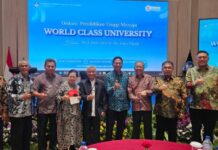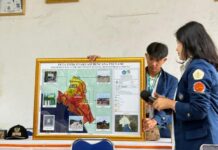
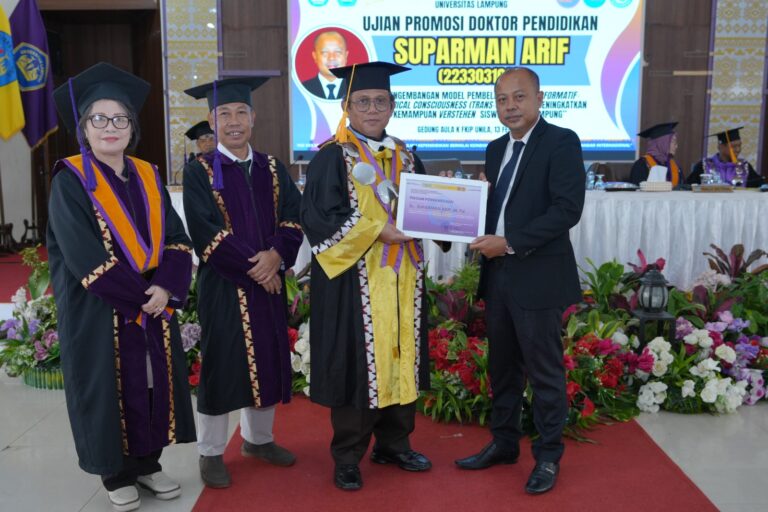
(Unila): The Faculty of Teacher Training and Education (FKIP) of the University of Lampung (Unila) held a doctoral promotion exam on Friday, February 13, 2025. The exam took place in the K Hall of FKIP Unila.
The doctoral promotion session was opened by Prof. Dr. Sunyono, M.Si., as the Vice Rector for Student Affairs and Alumni as the representative of the Chair of the Examining Team, Prof. Hasan Hariri, S.Pd., MBA, Ph.D., as the Examining Secretary, Prof. Dr. Risma Margaretha Sinaga, M.Hum., as the Promoter, and Dr. Dedy Miswar, S.Si., M.Pd., as the Co-Promoter.
Also present were Dr. Albet Maydiantoro, M.Pd., Dr. Viyanti, M.Pd., as internal examiners, and Prof. Dr. Nunuk Suryani, M.Pd., as Director General of Teachers, Education Personnel, and Teacher Education as external examiners.
On that occasion, Suparman Arif successfully presented his dissertation entitled “Development of the Transformative-Historical Consciousness (Trans-His) Learning Model to Improve Verstehen Ability of High School Students in Lampung”.
This research is motivated by the low ability of verstehen or deep and empathetic understanding of high school students in history learning, which has so far been dominated by memorizing chronological facts.
Initial data shows that as many as 70.4% of students feel that history learning has not been fully integrated with the ability to understand the meaning of past events that are relevant to today’s life.
“History learning so far has tended to emphasize only cognitive aspects, so that students have not been optimal in interpreting historical values reflectively and contextually.”
The Trans-His model developed integrates transformative learning and historical awareness through five main syntaxes, namely activating events, identifying current assumptions, encouraging critical self-reflection, encouraging critical discourse, and the opportunity to test new paradigms/perspectives.
The research results show that the Trans-His learning model has a content validity level of 92.35% and a construct validity of 92%, making it highly suitable for use. Field trials have proven that this model is effective in significantly improving students’ verstehen abilities.
On that occasion, Prof. Dr. Nunuk Suryani, M.Pd., provided input to Suparman Arif that low student learning outcomes were partly influenced by teacher competency which was still low nationally, so further research needed to be directed at strengthening teacher abilities, including in the development of teaching materials and high-level thinking questions.
One factor contributing to low learning outcomes and student motivation is the nationally low level of teacher competency. No matter how good digital media and technology are, without adequate teacher skills, results will be suboptimal.
“Going forward, I hope further research can identify teacher competencies that need to be improved, including in the development of teaching materials and higher-order thinking questions.”
Through his research, Suparman Arif offers an approach to history learning that is not only oriented towards mastering the material, but also towards strengthening students’ historical awareness and reflective abilities.
The Trans-His model is expected to encourage students to become active learners who are critical, empathetic, and able to connect past events with present-day realities.
It is hoped that this idea can serve as a reference for educators, curriculum developers, and policy makers in presenting meaningful history learning.
Through the Trans-His model, students are expected to improve their historical understanding and awareness reflectively and contextually, in line with the demands of 21st-century learning. [Muzamil Kakar]