
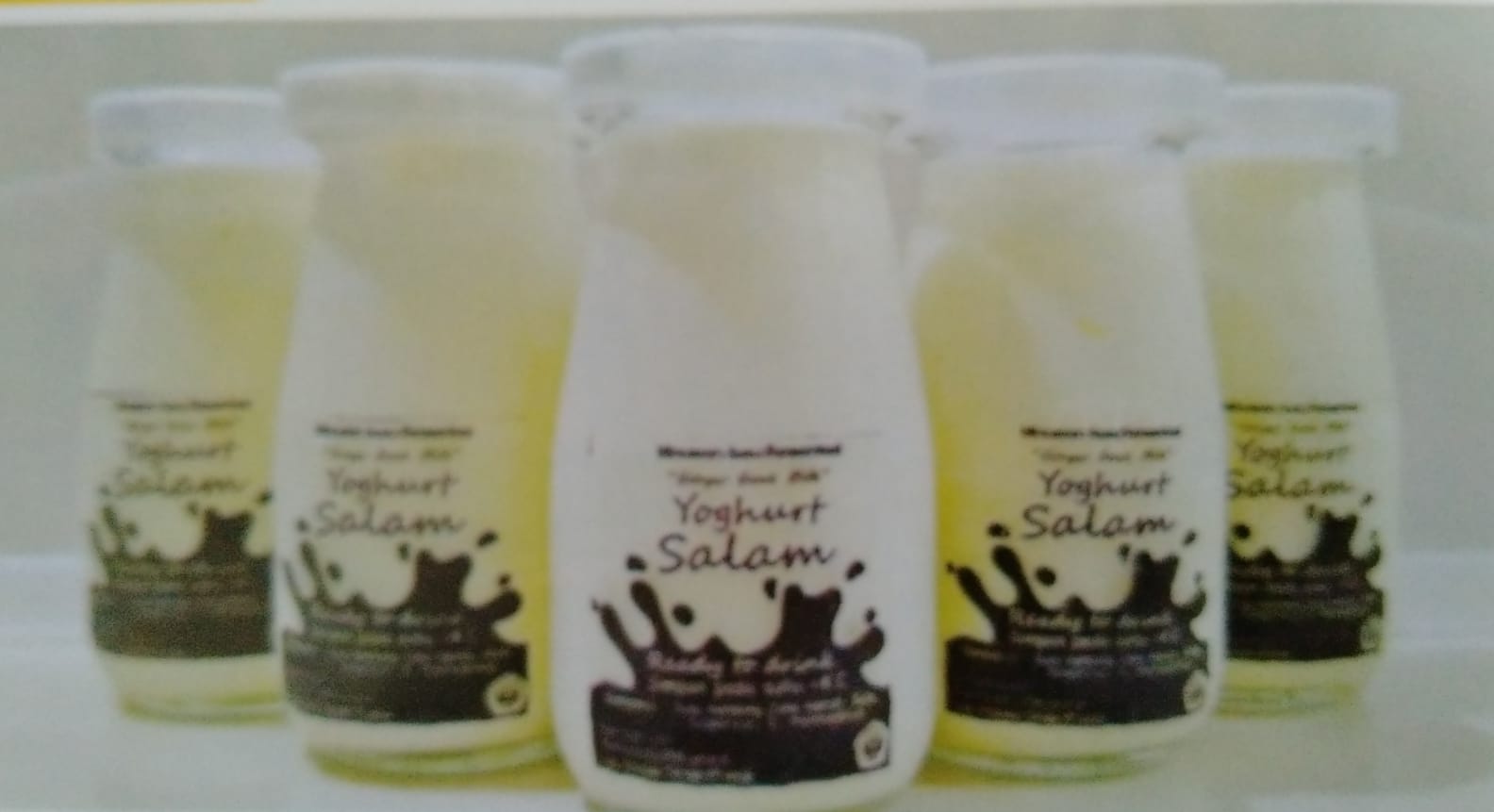
(Unila): A team of researchers from the Animal Husbandry Study Program, Faculty of Agriculture, Universitas Lampung (Unila) undertook an innovative study to create goat’s milk yogurt with red ginger extract. This product not only contains probiotics and vitamin D, but it can also boost the inhibition of pathogenic microorganisms.
The researchers that worked on the study titled “Application of Milk Fermentation Technology Utilizing Local Food Resources to Enhance Immunity During the Covid-19 Pandemic” involved Dr. Veronica Wanniatie, S.Pt., M.Sc., Dr. Arif Qisthon, M.Sc., Dr. Ali Husni, M.P., and Dedy Yuliawan, S.E.,
Veronica Wanniatie stated that the research was conducted between April and December 2021, when the Covid-19 outbreak was spreading. People are recommended to consume foods that help boost the immune system, such as yogurt and red ginger, which contain probiotic and antibacterial bacteria.
Veronica further explained when interviewed in her office on Thursday, March 24, 2022″Therefore, I blended goat’s milk with red ginger to maximize the immune-boosting advantages during the Covid-19 pandemic.
According to Veronica, she purchased 20 liters of Etawa Peranakan (PE) goat milk from a farmer in Metro City for her investigation.
“Then, around 5 kg of red ginger were purchased from the Gintung Main Market in Bandar Lampung. I chose PE goat’s milk because it is a quality animal product in the province of Lampung,” she explained.
The research was conducted at the Unila Livestock Production Laboratory and the Lampung State Polytechnic Agricultural Product Technology Laboratory.
First, goat’s milk was pasteurized at 72.2 degrees Celsius for approximately 15 seconds, then inoculated at 43-45 degrees Celsius with bacteria using a commercial starter comprising Lactobacillus bulgaricus and Streptococcus thermophylus bacterium.
After adding ginger extract, the mixture was incubated for four hours at 37 to 40 degrees Celsius. Four treatments were evaluated, including a mixture of yogurt and 1 percent red ginger (T 1), yogurt and 2 percent red ginger (T 2), yogurt and 3 percent red ginger (T 3), and yogurt and 4 percent red ginger (T 4), with the control consisting of goat’s milk yogurt or 0 percent red ginger (T 0).
Following this, antimicrobial activity testing, microbiological testing, chemical composition testing, physical property testing, antioxidant content testing, and organoleptic testing (sensory testing) were conducted.
“According to the findings of the study, the addition of red ginger boosted the suppression of the activity of E. Coli, Bacillus cereus, and S. Aureus, to varying degrees for each percentage of red ginger addition,” she added.
The findings showed that the average suppression of E. Coli bacteria by goat’s milk yogurt with red ginger extract varied from 8,980 to 9,280 mm, Salmonella sp bacteria from 8,800 to 9,433 mm, B, Cereus bacteria from 9,743 to 11,180 mm, and S. Aureus bacteria from 8,885 to 10,200 mm.
The yogurt mixture containing 1 percent red ginger inhibited E.coli and S. aureus bacteria significantly, but a yogurt mixture containing 3 percent red ginger inhibited B. cereus the most. The combination of yogurt and red ginger did not, however, suppress Salmonella species to a deadly degree.
In the organoleptic test, the panelists preferred the flavor of yogurt blended with 1 percent red ginger since the ‘prengus’ flavor of goat’s milk was diminished, while the red ginger flavor was not overpowering. In contrast, red ginger extract with a concentration of 3 to 4 percent tastes overly strong and tends to be bitter due to the high ginger content.
Veronica noted, when examined from the perspective of the chemical composition, fat continues to increase since red ginger includes fat, namely essential oils, for variable protein content, although water content has no influence.
“In addition, physical quality results indicated that acid content ranged between 0.1 and 0.5, pH ranged between 3.72 and 3.83, viscosity ranged between 6.86 and 9.57 CPs, and specific gravity (BJ) was between 1.011 and 1.035 g/vol.
“It tastes really sour, but it’s delightful because it contains acid and fiery red ginger, which boost the benefits as a probiotic beverage,” she explained.
These findings were published in the Proceedings of the International Conference on Sustainable Resource and Environment under the heading Physicochemical and Microbiology Quality of Goat’s Milk Yogurt with the Addition of Red Ginger.
Finally, four undergraduate students, Panca Apriky, Yufi Diana Safitri, Arlintia Widiawati, and Mauly Aulia Putri Borneo, were all included in the study and all had different interests and titles for their undergraduate research. [PR Team]