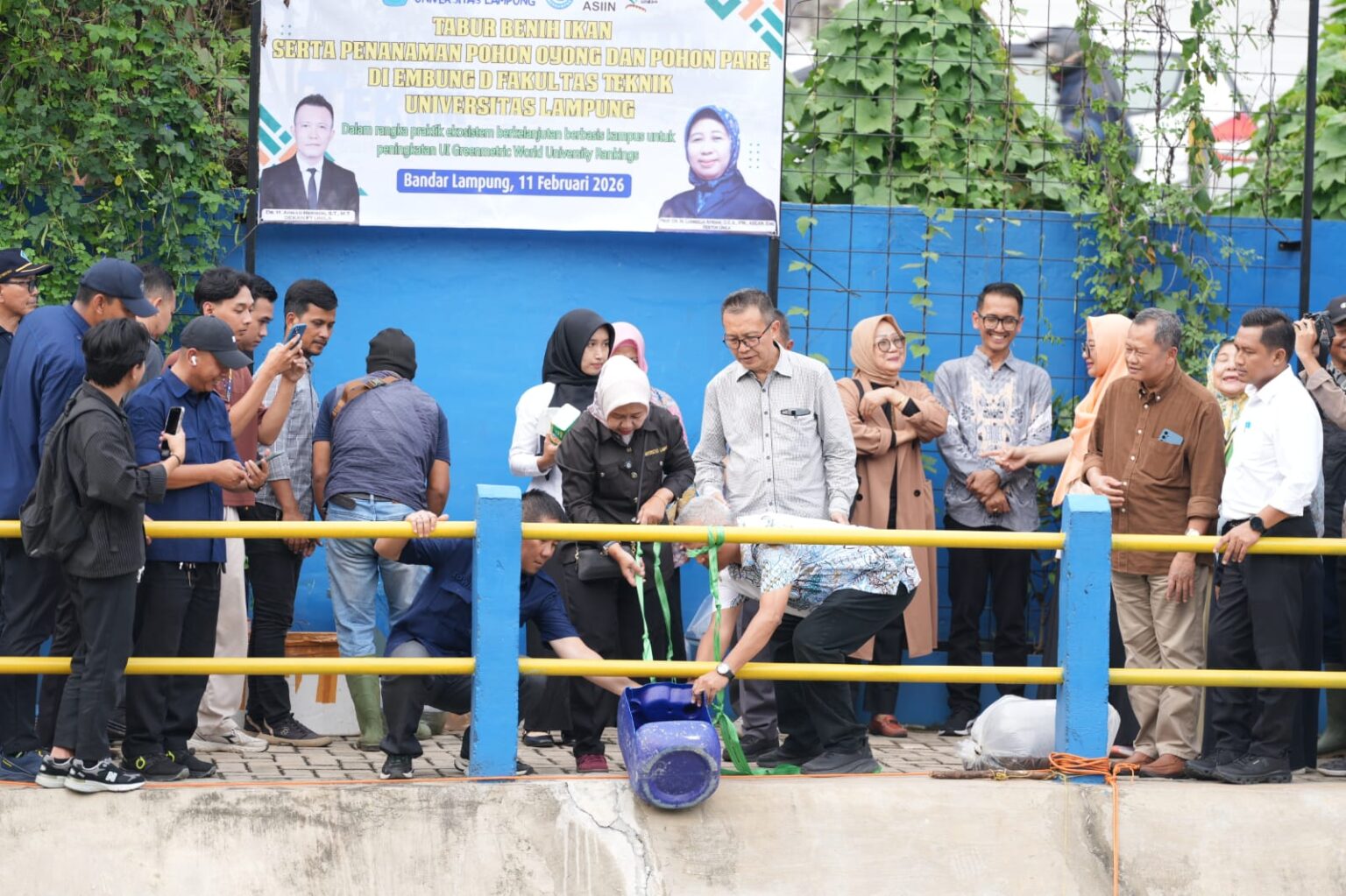
(Unila): The Faculty of Engineering (FT) of the University of Lampung (Unila) carried out fish seed sowing activities and planting luffa and bitter melon plants, on Wednesday, February 11, 2026, at the FT D Reservoir.
The activity was attended by Unila Rektor Prof. Dr. Ir. Lusmeilia Afriani, DEA, IPM., ASEAN Eng., Dean of the Faculty of Engineering Dr. Ahmad Herison, ST, MT, Vice Dean for Academic Affairs and Cooperation Misfa Susanto, ST, M.Sc., Ph.D.
Next, the Vice Dean for General Affairs and Finance Donny Lesmana, ST, M.Sc., Vice Dean for Student Affairs and Alumni Prof. Masdar Helmi, ST, DEA, Ph.D, heads and secretaries of departments, heads of study programs, lecturers, heads of general affairs, and team leaders at FT Unila.
Dr. Ahmad Herison said that the distribution of fish seeds had actually been planned for a long time, but the condition of the reservoir at that time did not allow for it.
He was grateful that the fish fry could finally be released today and hoped that they would survive and thrive. He also requested Unila’s support in providing fish feed.
“We’ve actually been planning to release these fish fry for a long time, but the reservoir conditions weren’t conducive at the time. Thank God, we can finally release the fry today. Hopefully, they’ll survive and thrive. We also ask for Unila’s assistance in procuring fish feed.”
Meanwhile, Prof. Lusmeilia Afriani said that the distribution of fish seeds in the Engineering Reservoir was a follow-up to her visit two weeks ago as an effort to beautify the area.
“I came here two weeks ago, hoping Embung Teknik would be even more beautiful. Thank God, today the fish seed distribution was successful, with feed provided by Unila.”
The activity continued with the distribution of patin, catfish, and tilapia seeds by the Rector of Unila, as well as the planting of loofah and bitter melon seedlings around the Embung D FT.
Unila provided a total of 200 kg of fish seeds consisting of 50 kg of catfish, 50 kg of patin fish, and 100 kg of tilapia, which were spread at four points in the reservoir location.
The selection of these fish species is adapted to the conditions of the reservoir and is expected to support the sustainability of the aquatic ecosystem, while planting luffa and bitter melon is part of the greening efforts as well as the productive use of campus open space.
This activity is expected to bridge the gap between the Engineering Reservoir and Environmental Engineering students as a learning experience. [Muzamil Kakar]