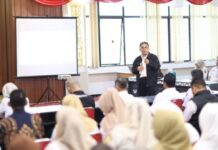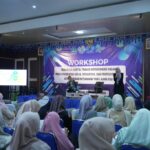
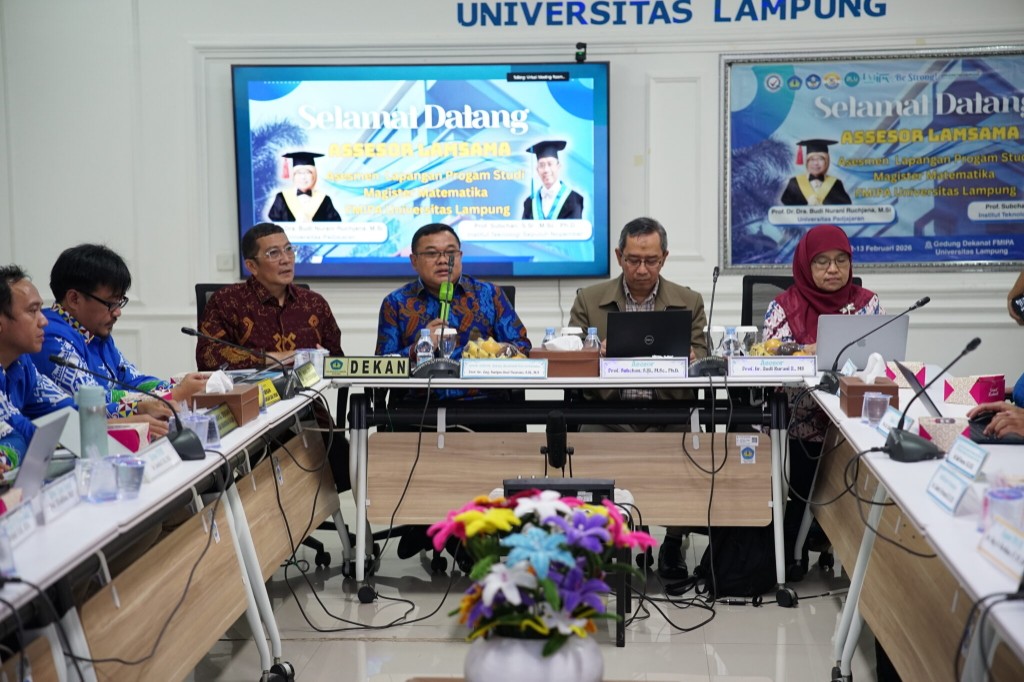
(Unila): The Masters (S-2) Mathematics Study Program, Faculty of Mathematics and Natural Sciences (FMIPA), University of Lampung (Unila) underwent a field assessment (AL) for accreditation from the Independent Accreditation Institute for Natural Sciences and Formal Sciences (Lamsama) on Thursday, February 12, 2026. The activity took place in the second floor meeting room of the Dean’s Office of FMIPA Unila.
The activity was opened by the Vice Rector for Academic Affairs of Unila Prof. Dr. Eng. Suripto Dwi Yuwono, S.Si., MT. The activity was also attended by the deans, vice deans of FMIPA, heads of bureaus, Director of Postgraduate Studies, heads of institutions, and heads of Academic Support Units within Unila.
Prof. Suripto Dwi Yuwono in his remarks said that field assessment is an important part of the external quality assurance process to ensure that academic governance, implementation of the tridharma, and learning outcomes in the Mathematics Master’s Program have been carried out in accordance with national higher education standards and the criteria set by Lamsama.
He emphasized that accreditation is not merely an administrative assessment, but rather a reflection of the consistency of quality, academic culture, and the institution’s commitment to improve the competitiveness of graduates.
The field assessment process was carried out by two Lamsama assessors, namely Prof. Dr. Budi Nurani R., MS, and Prof. Subchan, S.Si., M.Sc., Ph.D.
Prof. Budi Nurani in his presentation emphasized the importance of alignment between the vision and mission of the study program and the implementation of the curriculum, graduate learning outcomes, and the research contributions of lecturers and students in the development of mathematical science.
He also highlighted the need for consistent documentation of internal quality assurance systems, traceability of academic data, and sustainability of human resource development programs.
Meanwhile, Prof. Subchan emphasized the Outcome-Based Education (OBE) curriculum, student involvement in research integrated with the scientific roadmap, and the relevance of thesis topics to the needs of scientific development and solving real problems.
He also clarified various supporting evidence, including study program governance, scientific publications, academic collaborations, and academic and non-academic services for students.
Field assessment activities include sessions on presenting study program profiles, document clarification, discussions with faculty and university leaders, interviews with lecturers, students, alumni, and educational staff, and reviews of facilities and infrastructure supporting learning and research within the FMIPA environment.
Through this field assessment, Unila hopes that the Masters Program in Mathematics can obtain optimal accreditation results as a form of commitment to maintaining and improving the quality of higher education in the fields of natural sciences and formal sciences.
This activity also serves as a momentum for ongoing evaluation and strengthening of study programs in facing the challenges of scientific development and societal needs. [Muzamil Kakar]