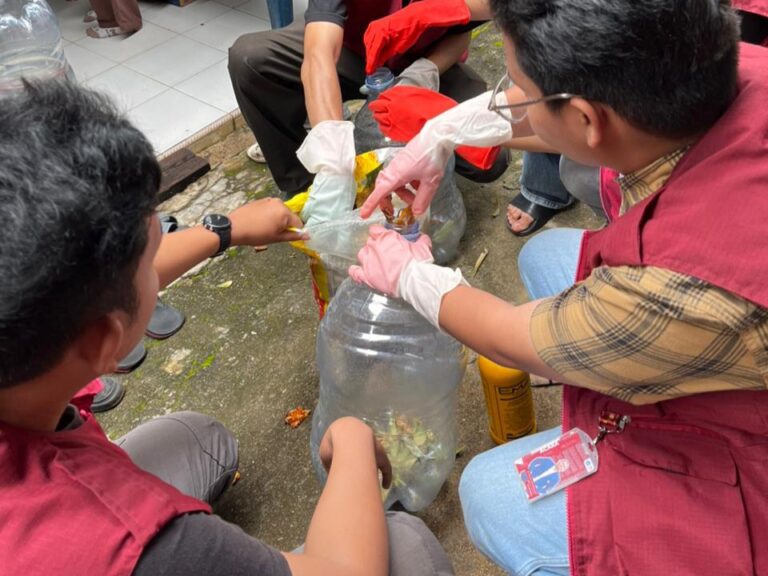
(Unila): Students of the Community Service Program (KKN) of the University of Lampung (Unila) carried out the Bulega work program (Catfish Cultivation in Gallons) and a Demonstration of Making Liquid Organic Fertilizer (POC) in RT 05, Rajabasa 2 Village, Rajabasa District, on Sunday, February 1, 2026.
This activity aims to encourage family food independence while increasing the sustainable use of household waste.
The BULEGA program is a catfish cultivation activity that utilizes used gallon jugs as the main medium, equipped with a tap as a drain for dirty water, making maintenance easier without having to lift the gallon.
After the gallon jug is cleaned and filled with water, the catfish fry are stocked according to capacity, then cared for with regular feeding and periodic water changes. This cultivation system is designed as a simple and economical solution that can be implemented in environments with limited space.
Meanwhile, the POC demonstration involved hands-on practice in making liquid organic fertilizer from household organic waste, such as vegetable and fruit scraps, fermented using EM4 and molasses. After the fermentation process, the resulting liquid is filtered and ready to be used as an environmentally friendly fertilizer with beneficial benefits for the community.
This activity was motivated by the socio-economic conditions of the RT 05 community, most of whom work as casual laborers and housewives, and still face limitations in meeting their daily food needs.
On the other hand, there is a large amount of plastic and organic household waste that is not being optimally utilized. Therefore, the BULEGA and POC programs were introduced as an effort to achieve self-sufficient food supply while simultaneously managing household-based waste.
This program was initiated by the Rajabasa 2 Village Community Service Group consisting of Heri Hermawan, Andrea Wijaya, Faizma Zia Illaya, Adinda Kris Oktaria, Langgeng Nugroho Akbar, Kayla Deswita Erianti, M. Alqawiyy Putra, Rizky Mayatika Putri, Tryolla Putri Noor Harvani, Imelia Putri, Muhammad Ghifari Juniansyah, M. Tajali Nasrullah, and Jovita Melita.
The BULEGA program has the advantage of not requiring large areas of land, being low-cost, and being applicable in densely populated areas. Meanwhile, POC excels because its manufacturing process is simple, environmentally friendly, utilizes household organic waste, and has the potential to provide utility and sales value to the community.
Tryolla Putri, as a group representative, explained that BULEGA was chosen because it is easy for the community to implement at a relatively low cost.
“Catfish farming in gallon jugs doesn’t require a large area and can be done in your yard. Besides providing a source of protein, utilizing used gallon jugs also helps reduce plastic waste in the environment,” he said.
He also added that the POC demonstration aims to enable the community to manage organic waste independently.
“By making liquid organic fertilizer, people can utilize vegetable and fruit waste to create products that are useful for plants and even have the potential to have a selling value,” he added.
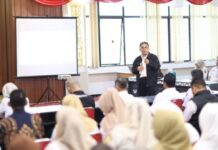
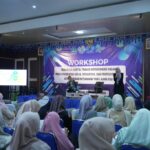
This activity involved students and the community, received permission and support from the local neighborhood association (RT), and collaborated with the Ruang Pangan Community. The residents’ enthusiasm was evident throughout the event, from the preparation of tools and materials, hands-on catfish cultivation, to the fermentation process of liquid organic fertilizer.
In addition to impacting family food security, this program is also expected to reduce the amount of plastic waste and household organic waste. Utilizing used gallon jugs and processing organic waste into biodegradable organic waste (POC) is believed to create a cleaner and more productive environment.
“We hope that the BULEGA and POC programs can be continued independently by the community, both to meet family food needs and as a source of additional income,” he said.
Through this program, KKN students not only contribute to improving family food security but also encourage sustainable waste management, thus creating a cleaner and healthier environment. [Muzamil Kakar]