(Unila): Early disaster awareness is crucial for building a resilient community that is ready to face emergency situations. In Pengajaran Village, North Teluk Betung, Lampung, the Community Service Program (KKN) team from the University of Lampung (Unila) Pengajaran 1 Village, Period I, 2026, implemented a socialization program entitled “Disaster Mitigation with the Regional Disaster Management Agency (BPBD) of Lampung Province.” This program took place on Wednesday, January 21, 2026, at SDN 1 Pengajaran.
This program aims to improve students’ understanding and preparedness for potential disasters in their school and home environments. The primary target group is third and fourth grade elementary school students, a group considered vulnerable but with high learning abilities. Through this program, students not only receive theoretical information but also receive training in implementing practical disaster mitigation measures.
The material was delivered by Mr. Wahyu Hidayat, SH, MH, M.Ag., a Disaster Analyst from the Lampung Province Regional Disaster Management Agency (BPBD), using an interactive and engaging approach. The presentation was tailored to the students’ ages, using simple language, short stories, and hands-on practice.
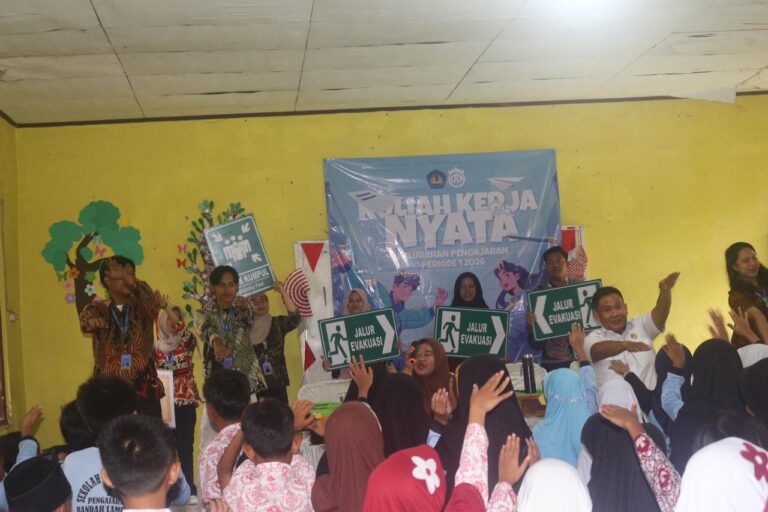
One of the featured methods is a disaster mitigation and evacuation simulation, where students follow movements while singing to better understand evacuation procedures. Community Service students act as evacuation route guides and role models, ensuring students follow procedures correctly. As an additional form of support, the community service students provide assembly point signs to the school, which serve as markers for safe locations in the event of a disaster.
This program implements the Communication, Information, and Education (KIE) principle promoted by the National Disaster Management Agency (BNPB), which aims to disseminate disaster information to all levels of society, including children. Disaster education has traditionally been focused on adults, yet children are a vulnerable group who need to be equipped with knowledge from an early age to enable them to be responsive and safe in the face of disasters.
The program was closely coordinated between the KKN team, the school, and the Lampung Provincial Disaster Management Agency (BPBD). The KKN team was responsible for permits, scheduling, and technical implementation, while the BPBD developed materials, delivery methods, and conducted simulations. Mitra Bentala also acted as mentors, helping explain technical mitigation techniques to students. This collaboration ensured the smooth running of the program from preparation to evaluation.
Challenges encountered during the program included varying levels of student understanding and time constraints. To address these challenges, the team employed interactive methods, accessible language, and hands-on simulations to help students effectively remember and practice disaster mitigation procedures. Supporting materials, such as assembly point signs, were also provided as visual reminders to keep students aware of evacuation routes and safe locations.
The response from students at SDN 1 Pengajaran was very positive. They enthusiastically participated in the simulation, especially when the alarm sounded as an early warning system (EWS). Students moved in an orderly manner toward the designated assembly point, with the Community Service Program students guarding the evacuation route using directional signs and assembly point indicators. This process provided students with real-world experience in how to respond quickly and appropriately to emergency situations.
This program is expected to foster a culture of disaster awareness through the provision of materials, hands-on simulations, and support for preparedness facilities. In addition to outreach and disaster mitigation simulations, students from the University of Lampung Community Service Program (KKN) in Pengajaran 1 Village, Period 1, 2026, also presented a gathering point sign to SDN 1 Pengajaran.
The signs serve as markers for safe locations in the event of an emergency and serve as visual reminders for students to identify evacuation routes and safe points within the school environment. This effort aligns with the BNPB’s IEC principles, which emphasize habit formation and concrete preparedness .
We hope that schools and the community, especially those in SDN 1 Pengajaran, will continue to support disaster education activities. Disaster mitigation and early preparedness are important steps to reduce disaster risks and build a safe, resilient, and emergency-ready school environment, in line with BNPB’s efforts through IEC,” said the KKN team from the University of Lampung, Pengajaran 1 Village, Period 1. [Muzamil Kakar]