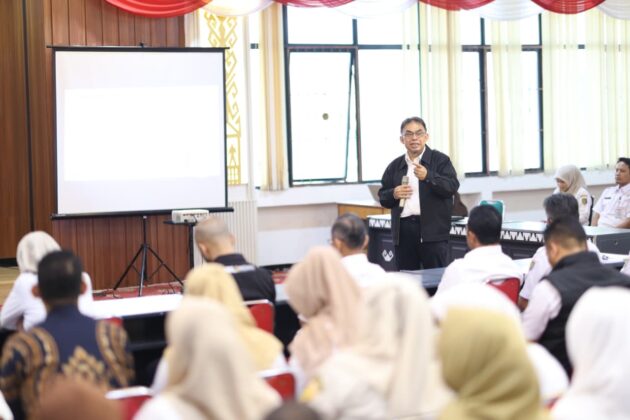
(Unila): The University of Lampung (Unila) has expressed its support for strengthening the regional innovation ecosystem through its participation in the launching event of the Innovation Clinic, organised by the Provincial Government of Lampung in collaboration with the Regional Research and Development Agency (Balitbangda) on Wednesday, 11 March 2026, at the Lampung Governor’s Office Complex.
This support is demonstrated through the presence of the higher education institution, which provides insights into the development of research-based regional innovation while simultaneously fostering synergy with local government in addressing the development challenges in Lampung Province.
The establishment of the Innovation Clinic represents a strategic step by the local government to encourage the emergence of various creative ideas capable of addressing developmental challenges and enhancing the quality of public services.
Through this platform, local government agencies are expected to develop innovations that are more structured, well-documented, and have a tangible impact on society.
During the event, Prof. Dr. Ayi Ahadiat, S.E., M.B.A., as a speaker, emphasised the importance of building an innovation ecosystem that involves various stakeholders. He asserted that regional innovation cannot operate in isolation but must be supported by collaboration among local government, higher education institutions, the business sector, and the community.
He articulated that the innovation clinic should genuinely function as a space for idea development, rather than merely a discussion forum.
“This regional innovation clinic is indeed owned by the local government; the clinic is entrusted with developing innovations, so every sector should have a space to generate innovations relevant to their field,” he stated.
According to him, local government agencies possess significant potential to generate various innovations that can enhance public service performance and foster the development of the regional economy.
Therefore, innovation needs to be developed systematically with the support of research, technology, and the strengthening of human resource capacities.
Prof. Ayi also underscored the importance of higher education institutions’ involvement in supporting regional innovation development. Higher education institutions play a role through educational activities, research, and community service that can yield various science-based solutions.
He cited that various research outcomes from universities could be further developed into innovations that benefit both society and the industrial sector. “In higher education, there is research and community service. The results can indeed become innovations if they are pushed towards downstreaming,” he remarked.
He noted that synergy between local government and higher education institutions is a crucial factor in strengthening regional innovation.
Universities can serve as centres for knowledge and technology development, while local governments play a role in implementing these innovations within policies and development programmes.
Additionally, he highlighted the importance of intellectual property rights protection for the innovations produced by both the community and institutions. With such protection, the innovations that emerge can hold economic value and simultaneously open opportunities for collaboration with the industrial sector.
Meanwhile, the Head of Balitbangda of Lampung Province, Yurnalis, S.IP., M.Si., representing the Governor of Lampung, in his speech conveyed that the current global changes require local governments to work in a more adaptive, responsive, and innovative manner.
He stated that innovation is one of the keys to enhancing the quality of public services while simultaneously strengthening regional competitiveness. Through innovation, local governments can provide more effective solutions to various resource limitations.
He reported that based on the measurement of the Regional Innovation Index by the Ministry of Home Affairs of the Republic of Indonesia, the Provincial Government of Lampung has reported 48 innovations with a maturity score of 52.89 and received an innovative designation.
However, he emphasised that what is most important is not merely the number of reported innovations but the tangible benefits experienced by the community.
“The most important aspect is not the designation itself, but whether the innovations facilitate services, expedite processes, save budgets, and are genuinely felt by the community,” he stated.
According to Yurnalis, the Innovation Clinic is expected to serve as a collaborative and incubative space for local government agencies in developing various innovative ideas. Through this facility, local government agencies can receive guidance in designing, developing, and reporting regional innovations in a more systematic manner.
He also asserted that innovation is not always synonymous with high technology. Innovations can arise from simplifying service procedures, digitising work systems, or developing more effective community empowerment models.
With the launch of the Innovation Clinic, the local government hopes to foster a work culture that is more creative, adaptive, and results-oriented. Furthermore, innovation is also expected to strengthen governance while encouraging the enhancement of regional competitiveness.
Yurnalis invited all local government agencies to utilise the Innovation Clinic as a strategic partner in developing ideas and solutions to various developmental challenges in Lampung Province.