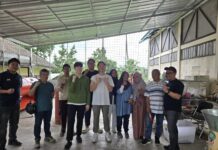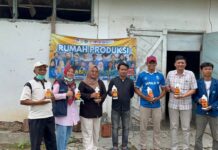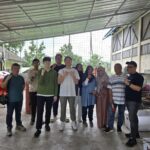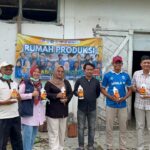
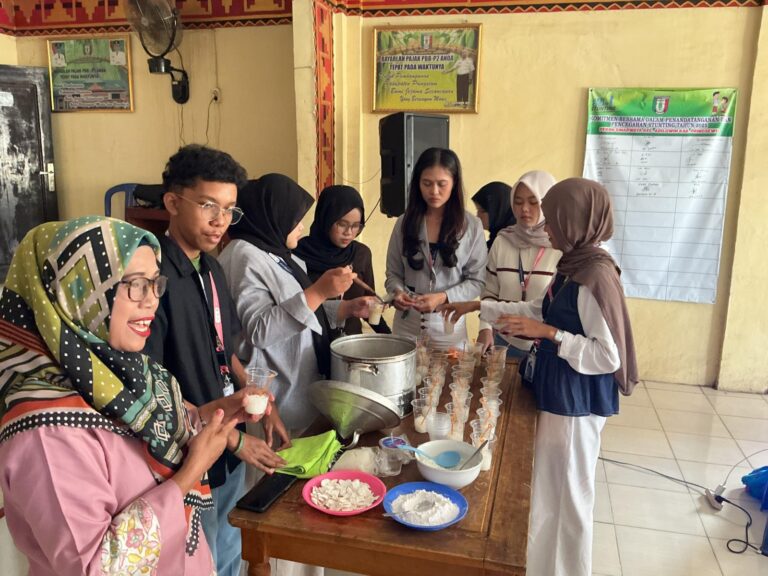
(Unila): Students of the Community Service Program (KKN) of the University of Lampung (Unila) carried out the Sosmocaf and Tekwan Mocaf Production work program, at the Sinarwaya Village Hall, Adiluwih District, Pringsewu, Wednesday, February 4, 2026.
The Sosmocaf program is a socialization activity for the production of mocaf (modified cassava flour) combined with the introduction of an innovative product, tekwan, made from mocaf flour. While tekwan typically uses tapioca flour, this program has developed a substitute for mocaf flour, which has characteristics similar to tapioca but with higher nutritional value.
Given the underutilized potential of cassava, it has been sold as a raw material at relatively low prices, making it less attractive to farmers for cultivation. This initiative aims to increase added value and boost the rural economy.
This program was initiated by the Sinarwaya Village Community Service Group consisting of M. Gufron Nabil H, Luthfiyyah Nur Fajrina, Amellia Putri, Sella Azelia, Gustaf Triyoga, Fatimahtuzzahra, Nadya Rahma, M. Dzaki Iqbar, Nadia Inggriani, and Syifa Nailah.
Gustaf, the person in charge of this program, explained that the relatively low price of cassava is one of the reasons farmers are reluctant to grow this commodity. They tend to choose other commodities like corn. However, if cassava is processed into mocaf (rice flour) or its derivatives, its selling value can increase significantly.
“Through this outreach, we want to demonstrate that cassava has significant economic potential if processed into mocaf (rice cake) or its derivative products. This will increase the selling value of cassava and open up new business opportunities for the community,” he said.
In addition, he explained that mocaf has characteristics that are close to tapioca flour because it comes from the same raw materials, but has better nutritional value.
“Until now, tekwan has been synonymous with tapioca flour. Through this innovation, we’re demonstrating that mocaf flour can also be a key ingredient in tekwan, offering equally good quality, if not even greater value,” he said.
This activity involved students, the community, and village officials. The community’s enthusiasm was evident throughout the event. Some even expressed their desire to try making mocaf and tekwan mocaf at home, especially around the holidays.
This outreach activity aligns with the Pringsewu Regent’s program on cassava downstreaming, which emphasizes the development of mocaf-based products as a way to strengthen the local economy. During the activity, KKN students provided education on the stages of mocaf flour production, from peeling the cassava, fermentation using fermented cassava, to drying and grinding into ready-to-use flour.
“Hopefully, in the future, farmers will be interested in growing cassava again, seeing the economic potential. If mocaf is produced independently and processed into various products, it will have a very positive impact on the economy of Sinarwaya Village,” he added.
With the implementation of the Sosmocaf Program, it is hoped that cassava will no longer be viewed as a low-value commodity, but rather as a strategic raw material capable of improving the welfare of the Sinarwaya Village community through innovation and proper processing. [Muzamil Kakar]