(Unila): A group of lecturers from the Krakatau Research Centre (KRC), Faculty of Engineering (FT), the University of Lampung (Unila) successfully invented the Unila-Tsunami Early Warning System (U-TEWS), particularly developed on the basis of a cheap device for measuring sea levels (PUMMA).
U-TEWS has advantages, a few of which are affordable price, as well as involving community in its operation and maintenance.
Dr. Ing. Ardian Ulvan, S.T., M.Sc., the coordinator of KRC, explained that PUMMA is a tsunami early warning system made up of many subsystems, including sensors, microcontrollers, data storage, power supply, and data/information processing (data centre).
PUMMA construction is made of stainless-galvanised steel since PUMMA is set to be placed in the middle of the sea and on the sand. The main structure of PUMMA is a pole with a box holding an ultrasonic tide-gauge sensor regulated by a microcontroller and used to calculate the sea level.
The microcontroller adjusts the sensor’s data acquisition time interval (every 1 second), translates sea level data and records images from the camera, and sends the data to the storage sub-system and data processing located in the cloud server, employing micro wave radio transmission
The last stage, the data processed in the platform data center can ultimately display sea wave height information in the form of tables and graphs, allowing for real-time tracking of sea levels.
PUMMA is also equipped with a CCTV camera that can record sea levels and send photographs to the server every four minutes.
Data and information from the U-TEWS PUMMA will be displayed on the electronic information boards (electronic information boards) placed in mosques along the coastal areas of Lampung and can be directly accessed via the website.
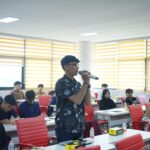
“The data displayed such as, sea level height, temperature, air pressure, and other parameters provide us with information of both volcanic and seawater activities,” said Ardian during an interview at the KRC/URO workshop at the Steel Lab, Faculty of Engineering, on April 1, 2021.
According to Ardian, once uncommon natural phenomena occur due commonly to earthquake, such as the sea level receding 50–70 centimeters from average in a short period or a height above the normal range, tsunami is expected to shortly occur.
The indication of tsunami would be first simulated. When the data indicate that tsunami is expected to occur, they will be sent in the form of a warning signal, which will in turn trigger sirens on mosques’ electronic information boards. This is an early warning to the public to save inhabitants particularly living near costal areas.
“Official information about a possible tsunami appears to first come from the Indonesian Agency for Meteorology, Climatology and Geophysics (Indonesian: BMKG) according to its authority to send tsunami early warnings (Presidential decree/Perpres). However, the society has a right to build the method to rescue themselves earlier shortly once a siren for a warning of danger sounds” Ardian remarked.
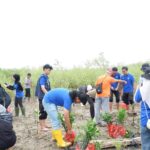
He explained that in early 2019, the Krakatau Research Center team undertook public awareness activities to ensure that the general public was aware of PUMMA, its devices, processes, and functions.
“Coastal communities do have local wisdom that can offer early warning when a disaster happens, such as when a hurricane reaches Kentongan. As a result, we are now ready to assist with U-TEWS PUMMA,” Ardian remarked.
PUMMA, he claims, can be installed on the pier’s edge or placed at sea at the height of 4–5 meters above sea level, out of the way of ship traffic. The Krakatau Research Center FT Unila research team is currently working on a PUMMA and information board that will be constructed on Sebesi Island in August 2021.
“At the moment, we can only make one PUMMA,” he said, “but then every single village in costal areas of Lampung is set to have one or two PUMMAs as an early warning system of tsunami.”
Ardian admitted that a shortage of funds was deemed as the main constraint to generate further PUMMA. One PUMMA costs us about seventy-five million rupiahs, excluding microwave radio and internet installations. He and his team will have to make an appeal for financial assistance to the third-party to support the program.
Awareness of Tsunami Disaster
ARDIAN said that the making of U-TEWS PUMMA was first initiated by the visit of Professor Wolfgang P. Burner, a professor from the University of Illinois at Chicago, to Unila in June 2013. Using electromagnetic sensors mounted on satellites, the professor, a sensor expert, has surveyed Indonesia’s natural resources.
“One thing, Burner emphasizes, is the risk of catastrophe due to the eruption of Mount Anak Krakatau (GAK). The results of mapping indicate that the GAK crater, which is 22 kilometres in length, is very active and the length of the crater may reach the mainland coast of South Lampung, Lampung Bay,” he said.
Before returning home, the professor suggested that people in this country be alert for the potential of disasters. The economic opportunity is regarded as being excellent, and the minerals are abundant, but the possibility of catastrophe is also huge. “A large eruption is expected to happen in the next 20-30 years,” Ardian said, quoting the professor’s message.
Several lecturers at the Faculty of Engineering were concerned with the incident, and in May 2018, the Krakatau Research Center (KRC) was formed. KRC was particularly intended for lecturers and researchers with interest in Krakatau to have a research collaboration according to their fields.
Coordination is necessarily made to keep research and community service activities sustainable and no overlapping activities of research and community services occur.
“Krakatau with all its economic potential as well as disasters, is located in the neighborhood of Unila. Consequently, Unila’s academic staff is necessarily well-versed in all facets of Krakatau,” Ardian remarked.
On December 21, 2018, Unila invited the Head of Indonesian Institute of Sciences (LIPI), Dr. Laksana Tri Handoko, M.Sc., to speak at a symposium on Industrial Revolution 4.0, Disaster Mitigation, and Synergy between LIPI and Unila, which was hosted by the Krakatau Research Center, the Integrated Laboratory Unit and the Centre for Technology Innovations.
The symposium is a follow-up to the Unila-LIPI Memorandum of Understanding, which was ratified on November 3, 2018. The Unila research team will conduct research work in collaboration with LIPI researchers on disaster research, especially Krakatau. The collaboration will enable Unila research team to make use of LIPI’s research facilitaties.
“The crater of Mount Anak Krakatau which collapsed the day after the symposium activity, on Saturday night, December 22 2018, resulted in the Sunda Strait tsunami, destructing some parts of the coastal areas of Lampung and Banten. On the 24th, a URO/KRC Unila team led by Mona Arif Muda Batubara (a lecturer in Informatics Engineering at Unila) shortly visited the site to track the tsunami’s impact from Sembalang to Bakauheni. Ardian said, “We are the first to provide aerial photo evidence of the tsunami-affected areas.”
The incident reinforced the KRC team’s resolve to devote full attention to developing a tsunami early warning system for Lampung’s coastal population. It turned out that the tsunami was triggered not just by the GAK eruption but also by the collapse of the GAK crater.
The Krakatau Research Center’s team intensively developed a sea-level measuring instrument in 2019 as the sea level is believed to have indicated accurate phenomena of the presence or absence of tsunami.
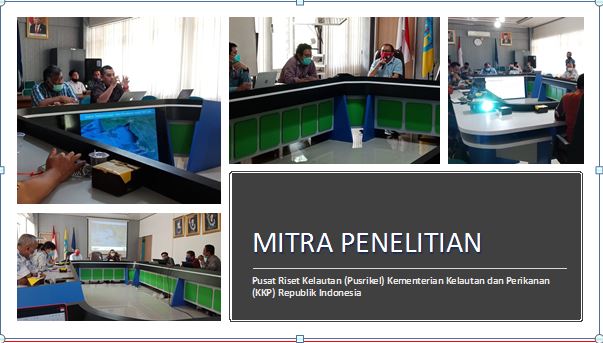
The team also created a sea-level measurement instrument in collaboration with the Ministry of Maritime Affairs and Fisheries of the Republic of Indonesia’s Maritime Research Center, leading to the development of the PUMMA-based Unila Tsunami Early Warning System (U-TEWS). The KRC programme has drawn interdisciplinary lecturers and scholars, and it is still growing. [PR Team]