(Unila): The international students pursuing a degree at the University of Lampung (Unila) shared their happiness and comfort of studying at the university. Not only is the campus provided with sufficient facilities, but it is supported by the Unila academic community with full of a tolerant spirit, which in turn contributes to a favourable environment for academic activities.
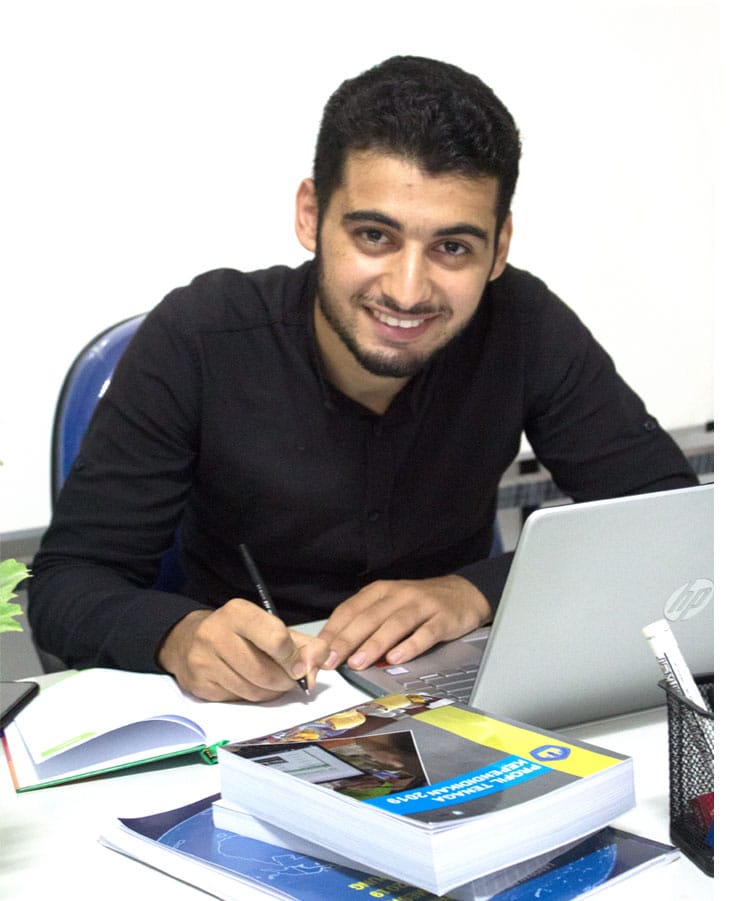
Raed Mohammed Hassan Arada, an international student from Palestine majoring in Electrical Engineering at the Faculty of Engineering said he was happy and comfortable because the Indonesian students, especially those at Unila, were respectful and humble.
“I have many Indonesian student friends at Unila. It is not difficult to get acquainted with them”. When interviewed by the unila.ac.id website team at the campus dormitory in mid-March 2021, Raed said, “Indonesian students are respectful and humble.”
Raed added that at Unila, it is easy to find students with different backgrounds, i.e., ethnic groups and regions, but all of them can keep peace and show respect for each other. He admitted that he was astounded by the openness fostered at campus to partake in academic experiences safely and comfortably.
Raed applied for Unila in February 2019 under a Palestinian Embassy-Unila partnership scholarship programme. He received the approval of Unila’s undergraduate student scholarship from the Palestinian Ministry of Education’s website.
“I had never recognized Unila before, but I was interested in studying in Indonesia. I had a careful look at the admission requirements, thank God, I could meet the requirements (to study at Unila). “I was contacted by Unila after a couple of weeks that the scholarship was granted,” Raed said.
Raed got a double benefit of the scholarship, tuition fee for eight semesters, a homestay, and a living allowance of IDR 2.5 million.
He admitted that he could not speak Indonesian when he first arrived at Unila. Then he joined the Unila’s Indonesian language skills learning programme (Indonesian for Foreign Speakers – BIPA), where he learned to read, write, and speak in Indonesian.
“I took an Indonesian language course for four months, but was still not fluent. To improve my Indonesian, I often practiced with my fellow international students, and things were getting much better”, he said.
Raed said that in the first year of study he struggled to grasp the subjects presented in Indonesian, particularly when taking the Pancasila Education and Indonesian Language courses. “I could understand mathematics because of the formulas and equations,” he explained.
Raed was lucky because he got along well with Indonesian students at Unila, who supported him in his studies and daily activities. Admittedly, until the third semester, Raed maintained a GPA of 3.7.
Raed found it hard to find Palestinian cuisine in Lampung for the first month while his tongue could not adapt to the spicy Indonesian cuisine. “For about a month, I cooked instant noodles or eggs in the dorm, instead of Indonesian rice. Raed, who collects ancient coins, said, “Now I like Indonesian foods, particularly rendang and Aceh noodles.”
Raed is in his fourth semester this academic year. He has been taking part in numerous outdoor-study events organised by the Unila’s Technical Implementation Unit for International Cooperation and Service Development (UPT-PKLI), among others, getting along in the Lampung arts and culture including Lampung batik and other local fabrics. He also actively gets involved in voluntary events.
“I am happy here in Indonesia. I plan to pursue my master’s degree at Unila. I often times tell about Indonesia to my siblings and they are interested in Indonesia” he said.
“The Indonesian culture that I love the most is when sacrificial animals are slaughtered in mosques, and the meat is distributed to the public,” Raed said. Raed never stops complimenting Indonesia on the safety and peaceful life of its peoples, including Lampung. According to him, the Indonesian people have a good sense of solidarity, something he does not see in Arab and Middle Eastern countries.
A Love of the Lampung Arts and Culture
Meanwhile, Vu Ngoc Thuy Trinch, an international student from Vietnam studying at the Faculty of Teacher Training and Education Unila majoring in Indonesian Language Education, admitted that she is always fascinated when watching the Lampung arts and cultural performances.
She has learned many traditional Lampung dances, the Kipas Dance and the Sigeh Pengunten Dance, during her four-year study at Unila.
She said she learned about traditional arts when she participated in an Indonesian Performing Arts course, allowing students to study traditional dances, such as Lampung traditional dances.
“The course required students to learn, practise and master traditional dances. Taking the course, I can now perform the Sigeh Pengunten and Kipas dances,” she explained.
She also learned Lampung language, one of her department’s obligatory courses. She learned not only the Lampung spoken language, but also the Lampung script.
Vu Ngoc Thuy Trench, who loves the popular Lampung nyeruit tradition of eating together with a special menu, fish, chilli sauce, and fresh vegetables, said, “I still don’t talk much Lampung yet, but only tabik pun – ya pun (Lampung greetings).”
Currently, she has been prepared for her results seminar of her undergraduate thesis entitled, “Pronunciation of Indonesian Consonants by Vietnamese Speakers.” Vu Ngoc Thuy Trinch plans to pursue her master’s degree in the Indonesian language after graduation hoping that she can make a career as an Indonesian language teacher once returning home to Vietnam.
Unila Global Initiative
With reference to the mandate from Unila’s Rector, Prof. Dr. Karomani, M.Sc., as well as the directive of the Vice-Rector for Planning, Cooperation, and ICT, Prof. Suharso, Ph.D., the International Office of Unila has main responsibilities as an initiative of Unila’s international programmes, said the Head of the International Office (henceforth PKLI), Dr. Ayi Ahadiat, S.E., M.B.A.
“The PKLI encourages international collaboration initiatives, for example, by facilitating lecturers or staff who wish to pursue their studies abroad, assisting Unila’s partnership with universities overseas, and assisting international students studying at Unila,” said Ayi Ahadiat.
The Unila’s global initiative plan, he claims, is in line with the strategic plans of the Ministry of Education and Culture and with that of Unila as well as with that of the higher education institution ranking cluster, which is based on the independent Learning – Independent Campus Program (MBKM).
Ayi explained that currently, Unila is concerned with developing partnerships with the 100 best universities in the world. In spite the fact that it is difficult, Unila has detailed cooperation with several universities overseas, Monash University in Australia, New Castle University in Australia, Kentucky University in the United States, Aoyama Gakuin University in Japan, Gunma University in Japan, and several European universities in Germany, France, Hungary, and Croatia among others.
According to Ayi, there were previously about 20 international students pursuing an undergraduate degree at Unila. However, the number of them has decreased to only ten students studying at Unila due to the COVID-19 pandemic,
The ten foreign students come from a number of countries, Palestine, (Raed Mohammed Hassan Arada studying at the Department of Electrical Engineering, Yahia Khalil Ibrahim Taha majoring Mechanical Engineering, Mohammed Zyad Zayd Alshurafa at the Department of Computer Science, and Amina Ata Abedelaty Elzaanin pursuing a Master’s degree in Management), Vietnam (Vu Ngoc Thuy Trench majoring in Indonesian Language Study Program).
Sri Lanka (Balapuwaduge Ishini Amand Mendis studying in the Department of English Education), Iraq (Umniya in Medical Education), Madagascar (Ramanjatovo Mathias Angelo in the Department of Communication, Andrianarivony Georges Leoni in the Department of International Relations), and Egypt (Abdelrahman Slaheldin Ahmed Hassan in the Department of Economics).
“Due to the pandemic, the number of foreign students is now decreasing, leaving only ten students. There were also those from Japan, but they drew back to their country due to COVID-19, “said Ayi.
Scholarship for Countries in Conflict
According to Ayi, Unila Rector, Prof. Karomani set a policy in 2021 to offer scholarships for 40 international students in total from conflict-affected countries such as Iraq, Syria, Palestine, Myanmar, and others.
“The rector wishes to highlight Indonesia’s cultural diversity and a tolerant spirit. The main idea underpinning this program is that Indonesia, which is framed by Pancasila and Bhinneka Tunggal Ika’s spirit, will come and serve to function as a role model to the rest of the world, “Ayi said.
Following this up, Unila will send notifications to several embassies informing them that Unila offers scholarships to partner countries in conflict. Furthermore, to find more information about this, the prospective international students can also visit io.unila.ac.id website.
“The prospective international students wishing to apply for admission at Unila can easily fill out the registration form right away with their details through the admission link,” Ayi explained.
Ayi points out that 25 international students have so far applied for admission. They come from countries which do not refer to the given countries for scholarship. This suggests that the interest of international students to pursue higher degrees at Unila continues to rise. He and his team will shortlist them. The scholarship should be granted for the students who are eligible, and those who are not eligible can study at Unila with a self-funded plan.
Regarding the scholarship budget for the 40 international students, the PKLI will not only rely on Unila funds, but Unila will also compete for support from the Ministry of Education and Culture’s Darmasiswa scheme, state-owned enterprises CSR funds, and large Indonesian corporations.
Meanwhile, Dedi Iswanto, S.E., Head of Subdivision of PKLI Administration, explained that the general requirement for the international students to apply for admission at Unila, among others, includes high school graduates or the equivalent of no more than three years in 2021 (high school graduates of 2021, 2020, 2019).
In addition, the prospective international students are also required to meet the following documents, such as a non-Indonesian passport, recent colour photograph (full face without hat, glasses, or accessories), certificate of high school diploma or equivalent, high school academic transcript or equivalent, ability to speak Indonesian or showing an Indonesian proficiency test certificate (TIBA) with a minimum score of 4, or a certificate of Indonesian Language Score (BIPA) with a minimum level of 3, a motivational letter, and a health certificate.
According to Dedi, the international students have a positive effect for Unila on the international promotion as well as reputation, which in turn open up opportunities for international collaboration in terms of teaching, research, and community services.
“Once returning to their home countries after graduation, these international students will act as ambassadors for Indonesia, applying the skills they have learned at Unila,” Dedi said. [PR Team]