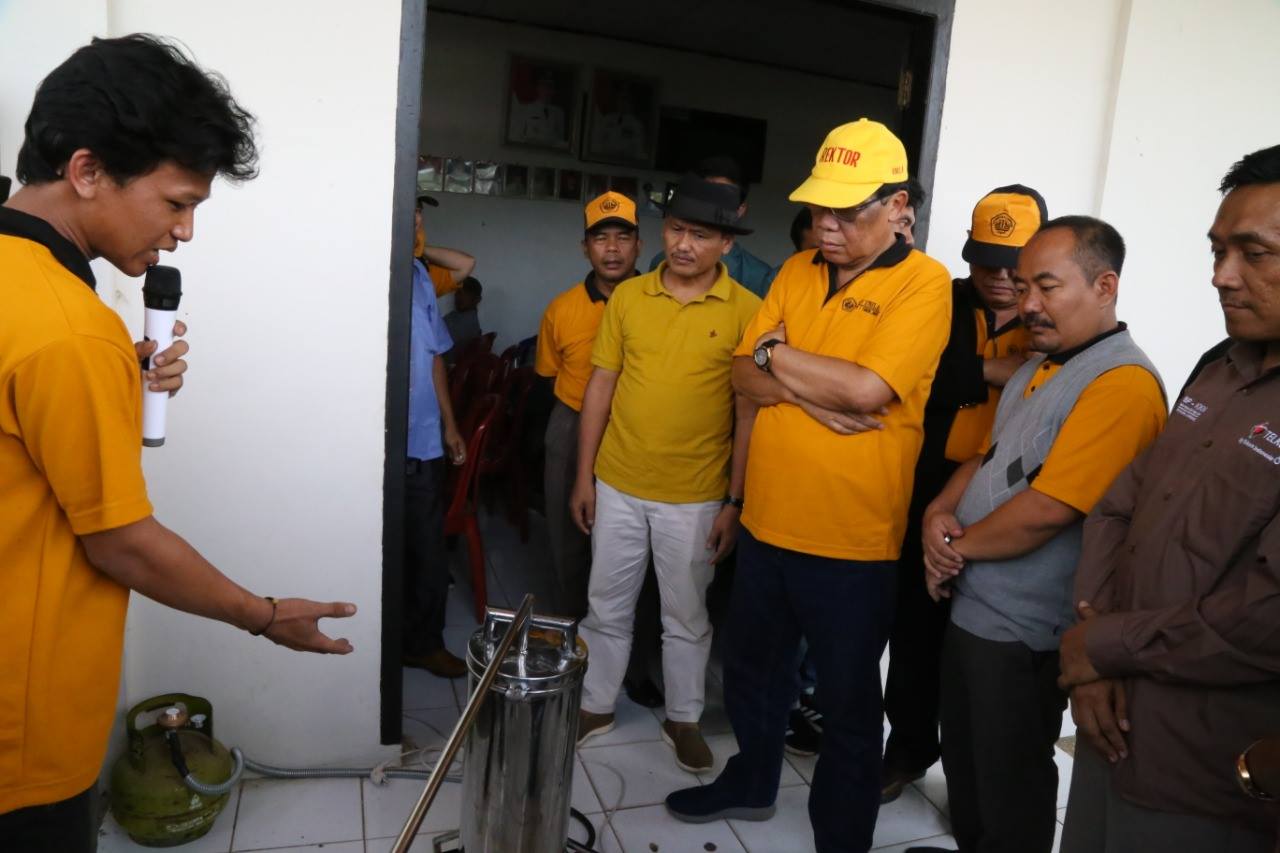
(Unila): Numbers of complaints from society about plastic waste has inspired students of the University of Lampung (Unila) to create a technology to solve this problem.
The technological innovation being developed was in the form of decomposing tubes using the pyrolysis method utilizes anaerobic combustion to produce reusable pure oil.
This technology was produced as a featured program of Unila Community Service (KKN) students Batch I January 2019, who were assigned in West Lampung Regency, precisely in Sukau sub-district.
According to M. Irfan (FMIPA Chemistry 2016), anaerobes manufacture of fuel or oil, in more specific, plastic waste materials which get complete combustion with the maximum heat pressure of 300̊ to 600̊ C might manufacture diesel or premium.
Irfan explained, the mechanism of his anaerobic device starts from rousting the plastic waste with maximum heat pressure inside the aluminum or iron kiln which is then connected to the same pipe and obtains regulation of few ice or little water particles.
“Maximum heat will result a rapid combustion, while the amount of produced oil will be accorded to the amount of decomposed waste as the input. In fact, this device has already started producing oil even in 100̊ C,” explained Irfan.
He also added, the material, which is decomposed and regulated, works automatically and evaporates in the second tube so that it eventually becomes pure oil.
The first oil produced is similar to diesel fuel, and if it gets advanced purification treatment, this oil can be classified as premium or pertalite which gears up to use.
Furthermore, on the same occasion, Rizqy Putra (FMIPA Chemistry 2015) as Irfan’s team-mate said, the main raw material was only plastic waste which is difficult to decompose.
The tube material used can be large or medium volume, according to the amount of plastic waste and heat that set. “It is usually rousted in 30 minutes, but it is according to the amount of material and heat chosen,” he explained.
This featured program launched by KKN students in Sukau Subdistrict was under the supervision of Field Supervisor (DPL) Dr. Saiful Bahri, M.A. from FMIPA Chemistry and Dr. Yul Martin, S.T., M.T. from Electrical Engineering Unila. [Humas]